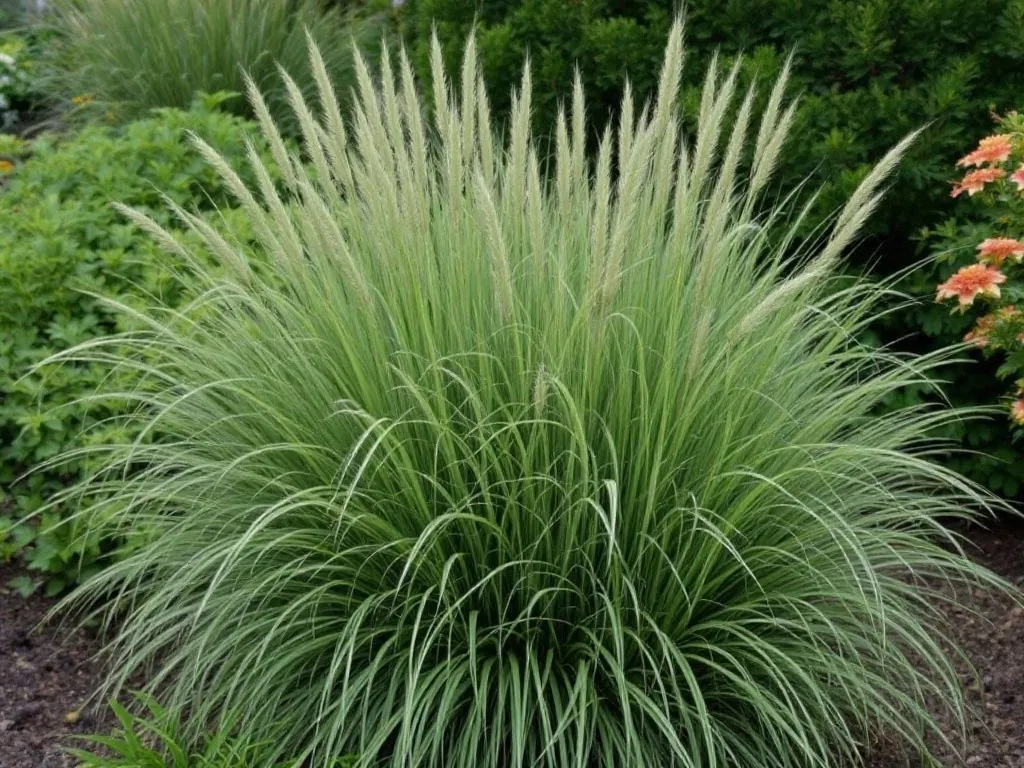
In short
- Very narrow, columnar habit — up to 2 m tall but only 0.4–0.6 m wide.
- Flower plumes appear as early as June–July, earlier than other ornamental grasses.
- Full sun to light partial shade; moderate water needs.
- Very cold-hardy and undemanding — one of the easiest grasses to grow.
- A sterile cultivar — does not self-seed and is not invasive.
- An icon of naturalistic gardens (the New Perennial Movement, Piet Oudolf).
Botanical data
- Family
- Poaceae (Poaceae)
- Height
- 1.5–2 m
- Width
- 0.4–0.6 m
- Habit
- Columnar
- Growth rate
- Moderate
- Position
- Full sun, Partial shade
- Soil
- Loamy, Humus-rich, Sandy
- pH reaction
- pH 5.5–7.8
- Moisture
- Moderate, Moist
- Bloom
- June–August
- Hardiness
- USDA 4a–9b
- Propagation
- By division
Characteristics
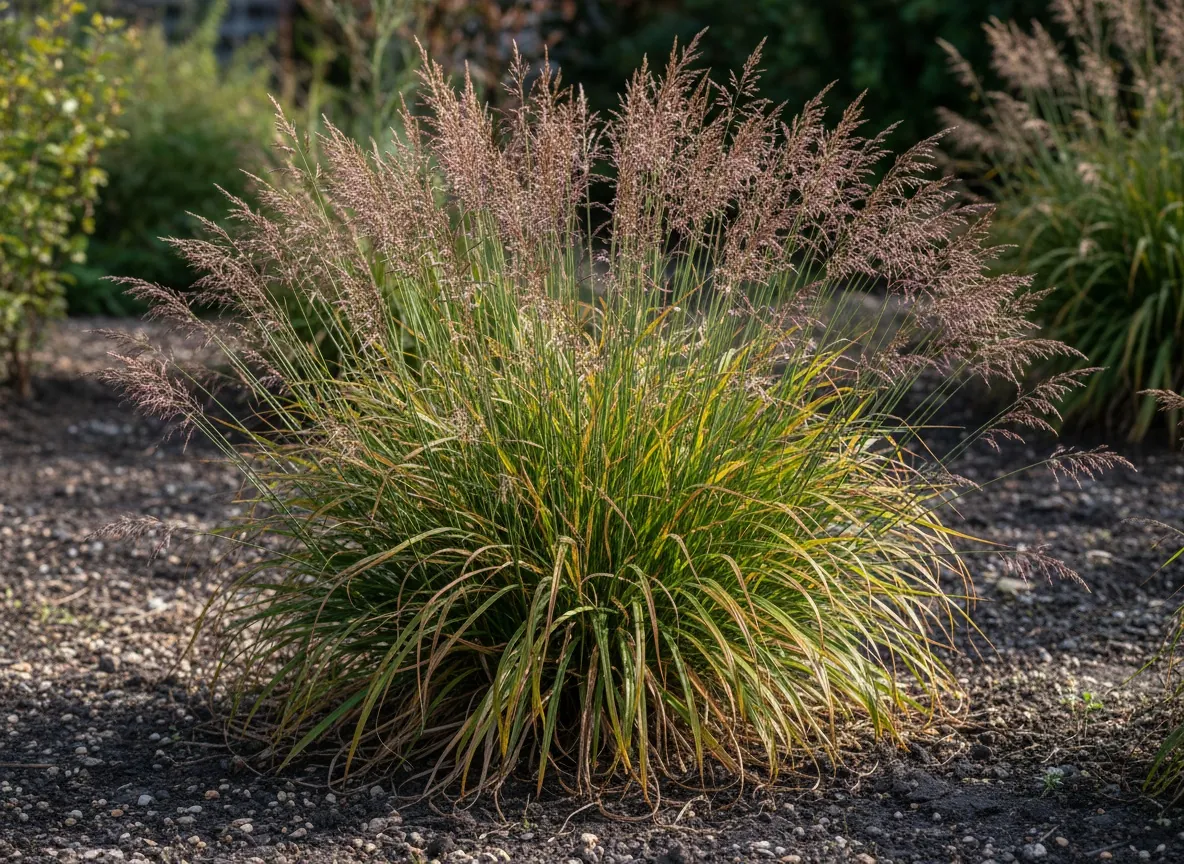
Forms a very narrow, strictly upright, columnar clump of slim, dark green leaves. As early as June, stiff, perfectly vertical stems shoot up from it, topped with slender, feathery plumes — initially greenish-purple, later fading to a straw, wheat-like tone — which hold their vertical form practically until spring, even after snowfall.
Growing and care
Watering
Tolerates short dry spells but grows best with consistently moderate soil moisture; also handles occasionally heavier, wetter soil better than most ornamental grasses.
Fertilizing
Very undemanding — extra feeding isn't needed, the plant grows well even in average garden soil.
Planting
Plant in full sun or light partial shade; tolerates a wide range of garden soils, from clay to sandy, as long as they aren't excessively dry.
Pruning
Cut the entire clump back low to the ground, to about 10–15 cm, just before new blades appear.
Companion plants
Good companions
The stiff, vertical plumes of feather reed grass create a striking structural contrast with the rounded flowers of prairie perennials — one of the most frequently repeated pairings in Piet Oudolf's naturalistic plantings.
Similar, moderate water needs and a great visual effect — the reed grass's vertical spikes break up the horizontal, carpet-like planes of lower perennials.
Bad companions
The narrow but very tall, stiff clump casts a long, narrow shadow that can affect plants placed right at its base during the day.
The evidence level indicates whether the relationship is backed by research, observation, or gardening tradition.
Toxicity
| For whom | Level | Notes |
|---|---|---|
| Humans | None | — |
| Dogs | None | — |
| Cats | None | — |
History and origin
The cultivar was selected in Germany in the first half of the 20th century at the nursery of Karl Foerster, one of the pioneers of German naturalistic gardening, and named in his honor. As the prairie style and the New Perennial Movement gained popularity around the turn of the 21st century (championed by, among others, Piet Oudolf), 'Karl Foerster' became one of the most widely planted ornamental grasses in the world and is regarded as an icon plant of that style — it appears in nearly every major public naturalistic planting, from New York's High Line to European city parks.
Uses
Excellent for mass or drift plantings, as a vertical accent breaking up lower perennials, in formal borders as a repeating rhythmic element, and in public urban greenery thanks to its low maintenance needs. Its narrow habit means it can be planted even in tight spaces, such as along paths or fences.
Trivia
- 'Karl Foerster' is a sterile hybrid cultivar — it produces no viable seed, so it is never invasive and never self-sows in the garden or beyond.
- It has received the prestigious British RHS Award of Garden Merit for its exceptional ease of cultivation and year-round ornamental value.
- Its early bloom time (June–July) sets it apart from most ornamental grasses, which don't flower until late summer or autumn — giving it a vertical accent in the border in the height of summer.
Frequently asked questions
When should feather reed grass 'Karl Foerster' be cut back?
In early spring, in February or March, just before new shoots appear — cut the whole clump back low to the ground. It's worth leaving the flower plumes over winter, since they hold their upright form beautifully even under snow and are among the most decorative winter grasses.
Is 'Karl Foerster' reed grass invasive, and will it spread through the garden?
No. It's a sterile hybrid cultivar that produces no viable seed and does not self-sow. It grows in a compact clump that slowly expands, making it one of the safer, non-invasive ornamental grasses to grow in the garden.
Why does this reed grass flower so early compared with other ornamental grasses?
That's one of its defining varietal traits — the plumes appear as early as June, while most ornamental grasses (such as miscanthus or fountain grass) don't bloom until August. This gives it a vertical, structural accent in the border in mid-summer, well before the autumn peak of other grasses.
Sources
- Plants of the World Online (POWO)Database (GBIF, POWO…)
- RHS — Calamagrostis × acutiflora 'Karl Foerster'Institution / botanical garden
My note
A private note for this plant — saved in your browser.