In short
- A CLUMPING bamboo — it does not run through the garden and needs no root barrier.
- Evergreen and frost-hardy to roughly USDA zone 5 — one of the hardiest bamboos.
- It prefers partial shade and shelter from winter sun and freezing wind.
- It has a high demand for water and nitrogen — unlike ornamental grasses, it likes feeding.
- Do not cut it like an ornamental grass — in spring only thin it out and remove old canes.
- Excellent for an evergreen hedge, a screen and large containers.
Botanical data
- Family
- Poaceae (Poaceae)
- Height
- 2–4 m
- Width
- 1.2–2.5 m
- Habit
- Clump-forming
- Growth rate
- Moderate
- Position
- Partial shade, Shade, Full sun
- Soil
- Humus-rich, Loamy, Sandy
- pH reaction
- pH 5–7
- Moisture
- Moderate, Moist
- Bloom
- —
- Hardiness
- USDA 5a–9a
- Propagation
- By division
Characteristics
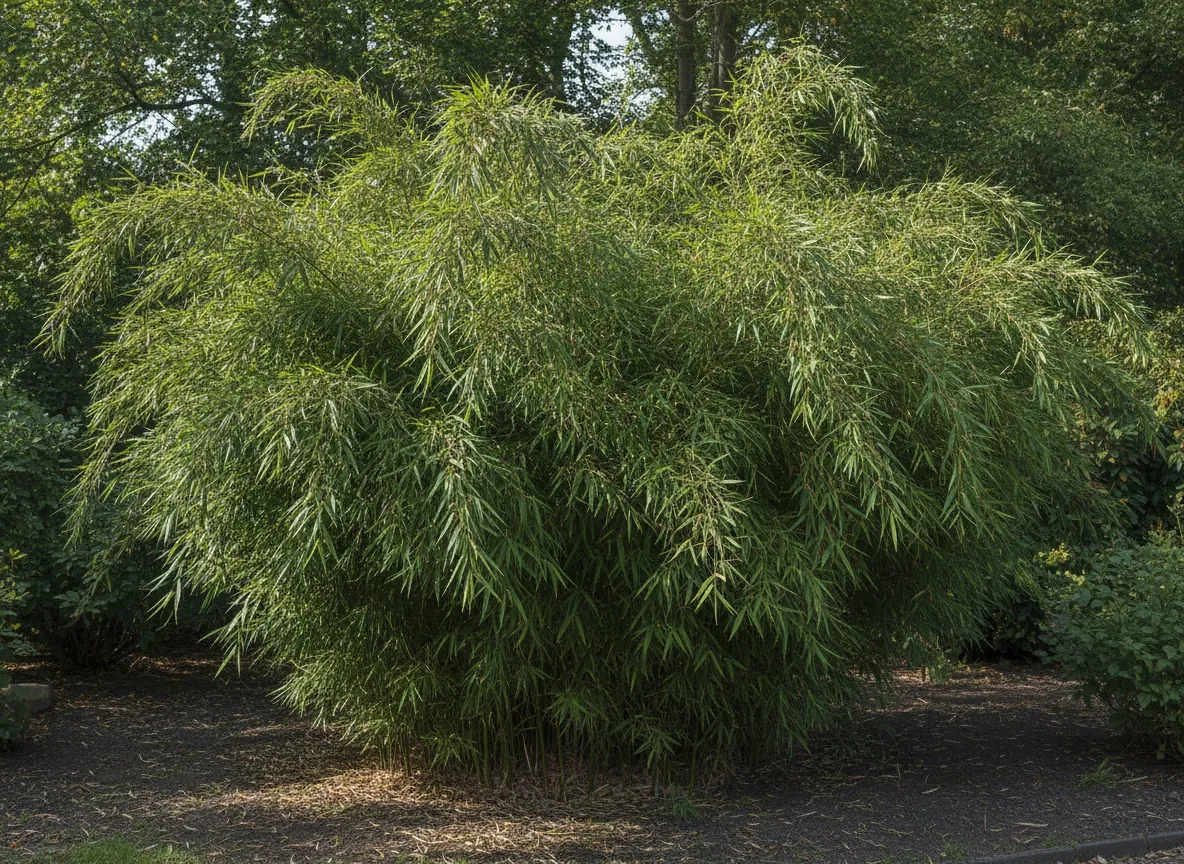
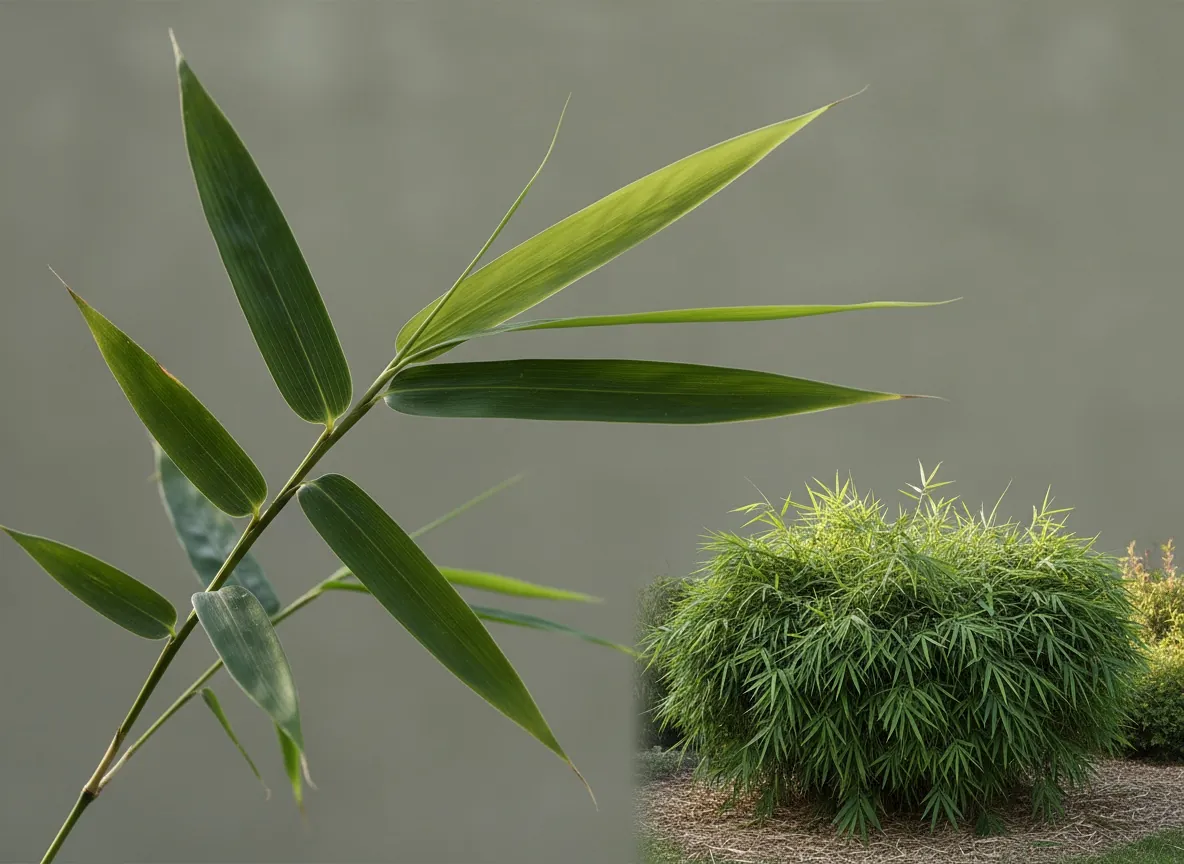
It forms a dense, clearly defined clump of numerous thin canes up to 1.5 cm in diameter, green at first and yellowing with age. The canes are straight, but under the weight of the fine, narrow-lanceolate leaves they arch gently outwards, giving the whole plant its characteristic umbrella shape — hence the trade name “umbrella bamboo”. The leaves are evergreen and stay on the plant all year; in hard frost they roll up, which is a normal protective reaction and not a sign of dying. The key practical feature is the rhizome type: Fargesia has a pachymorph rhizome, that is a short and compact one, so the clump widens by a few centimetres a year and stays where it was planted. It flowers extremely rarely, producing inconspicuous, green-brown spikelets typical of grasses.
Growing and care
Watering
It has a large and constant demand for water — leaves rolling into tubes are a sign of drought. It must also be watered in winter during long frosts without snow: the plant is evergreen and still transpires, while frozen soil supplies it with no water, so the leaves dry out.
Fertilizing
Unlike ornamental grasses, bamboo likes generous nitrogen feeding — an ordinary lawn fertiliser works well. The last feed by July at the latest, so that the canes have time to harden off before winter.
Planting
A hole twice as wide as the root ball, the soil enriched with compost but free-draining. A position sheltered from freezing wind and from the south-westerly winter sun. A root barrier is not needed — this is a clumping bamboo.
Pruning
Fargesia is not cut to the ground. In spring you cut out individual old, discoloured or frost-damaged canes right at the base and thin out an overly dense clump. Height is regulated by shortening the canes above a chosen node — bamboo does not regrow upwards from the cut, so the cane will stay at that height and will put out side branches.
Companion plants
Good companions
The classic underplanting beneath a bamboo clump — the hosta tolerates partial shade and moisture, and its broad leaves contrast with the fine, delicate foliage of the Fargesia.
Fern and bamboo share the same requirements (partial shade, humus-rich, moist soil) and together create a convincing picture of a mountain Asian understorey.
Similar needs — acidic, humus-rich soil, shelter from winter sun and constant moisture; both species are evergreen, so together they form a dense, year-round screen.
Bad companions
They spread by long runners throughout the garden and within a few seasons move into the Fargesia clump, smothering it and making it impossible to tell the two plants apart when removing them.
It requires a dry, poor and alkaline position in full sun — the generous watering and nitrogen feeding that bamboo needs quickly destroy it.
The evidence level indicates whether the relationship is backed by research, observation, or gardening tradition.
Toxicity
| For whom | Level | Notes |
|---|---|---|
| Humans | None | — |
| Dogs | None | — |
| Cats | None | — |
| Horses | None | — |
History and origin
The species was collected in central China by Ernest Wilson in 1907 and named after his daughter Muriel. For decades it was known in the trade as Arundinaria murielae and Sinarundinaria murielae, and only later was it included in the genus Fargesia. Almost all specimens grown in Europe in the 20th century came from a single collection by Wilson, that is they were one clone — which had dramatic consequences in the 1990s, when across the whole of Europe they began to flower and die simultaneously.
Uses
For evergreen hedges and screens (considerably safer than running bamboos), as a backdrop to borders, for Asian and woodland gardens, as a specimen plant and for large containers on terraces and patios. In a container it requires exceptionally regular watering and protection of the root ball in winter, because roots in a pot freeze through far faster than in the ground.
Trivia
- Bamboos are monocarpic: they flower once every several decades and then die. Umbrella bamboo has a cycle of about 100 years, and all plants derived from the same clone flower simultaneously all over the world, regardless of climate — exactly what happened in the 1990s, when the European specimens from Wilson's single collection flowered and withered almost at the same moment. Today's cultivars, such as “Simba” or “Jumbo”, derive from later, younger seedlings, so their flowering is not to be expected for decades to come.
- The mass flowering of bamboos in China is a real problem for giant pandas — Fargesia is one of the staple plants of their diet, and the death of an entire bamboo population deprives them of food for many years.
- Leaves rolled up on a frosty day are not a symptom of drying out but a way of limiting evaporation — after a thaw they unroll again.
Frequently asked questions
Will Fargesia spread all over the garden and does it need a root barrier?
No and no — this is the most important thing to know before buying. Fargesia is a clumping bamboo: it has a short, compact rhizome, so the clump widens by a few centimetres a year and stays where it was planted. A root barrier is unnecessary. Running through the garden is a matter for running bamboos, above all the genus Phyllostachys, whose shoots can emerge several metres from the parent plant and for which a barrier is essential.
Will Fargesia survive winter in Poland and why do its leaves roll up?
Yes, it is one of the hardiest bamboos — it withstands roughly USDA zone 5, so in Poland it overwinters in the ground in most regions. The rolling of the leaves in frost is a normal protective reaction limiting evaporation, not a sign of dying. The greatest threat is not the frost itself but desiccation: an evergreen plant transpires in winter too, and it cannot take up water from frozen soil. The position should therefore be sheltered from winter sun and wind, and during long frosts without snow it is worth watering it on a milder day.
How should Fargesia be pruned?
Quite differently from ornamental grasses — never cut the whole clump to the ground, because bamboo is evergreen and such a cut strips it of its entire assimilation apparatus. In spring, in April, you cut out individual old, discoloured or frost-damaged canes right at the base and thin out an overly dense clump. Height is regulated by shortening a cane above a chosen node: bamboo does not regrow upwards from the cut, so the cane will stay at that height and will only branch sideways, thickening up — which is desirable in a hedge.
Sources
- Plants of the World Online (POWO)Database (GBIF, POWO…)
- RHS — Fargesia murielaeInstitution / botanical garden
My note
A private note for this plant — saved in your browser.