In short
- Extremely frost-hardy (zone 3a) — it withstands frosts below -30 °C, but not winter wet.
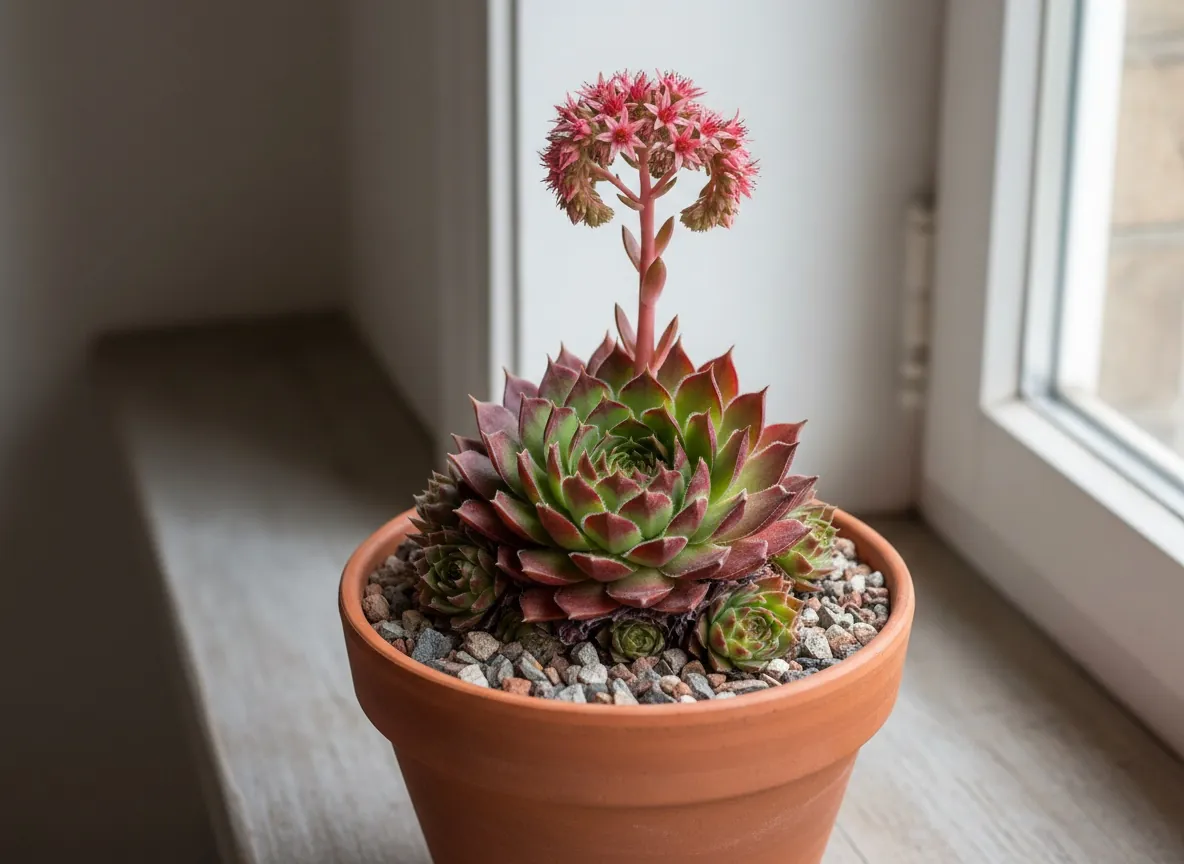
- Monocarpic: the rosette flowers only ONCE in its life and then dies — this is normal, not a disease.
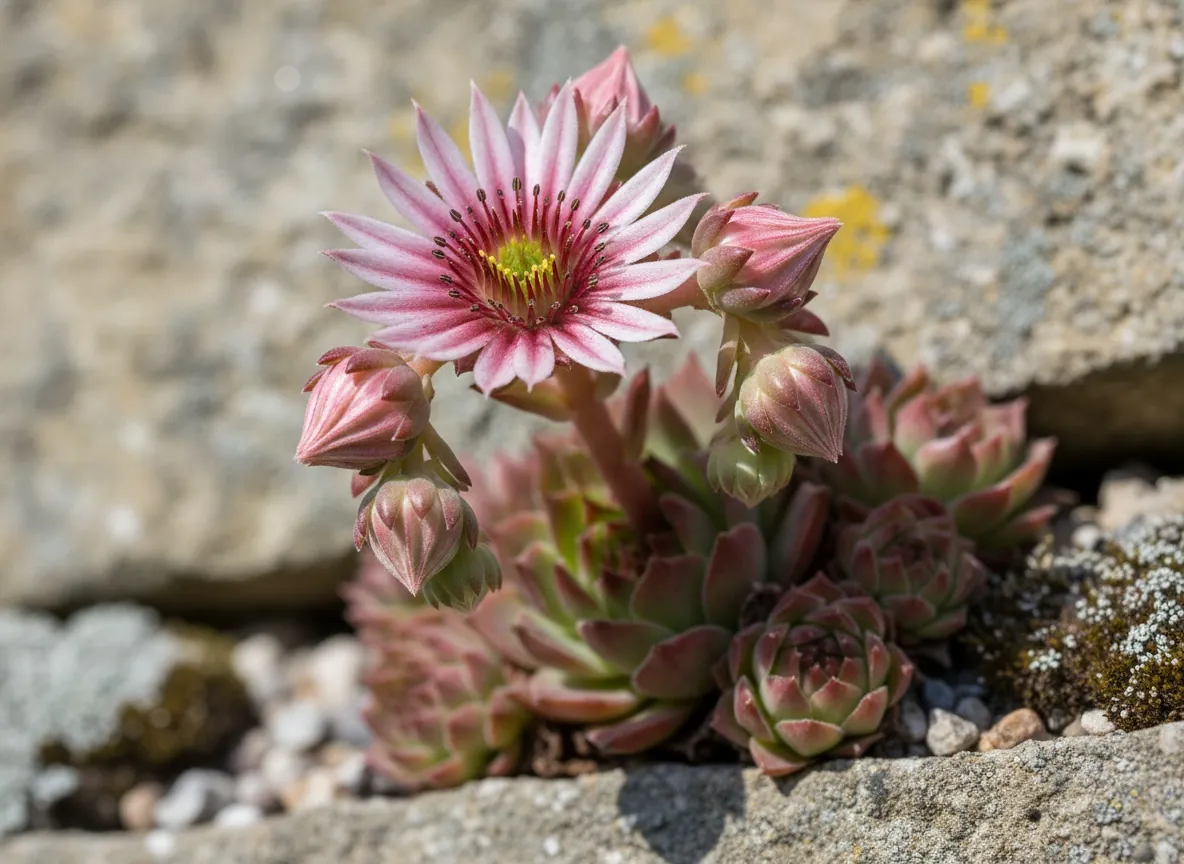
- The dying rosette is replaced by numerous offsets on stolons (“hen and chicks”), so the clump does not perish.
- It requires full sun and an extremely free-draining, poor substrate — do not fertilise.
- It needs practically no watering in the ground; in a container only during prolonged drought.
- Traditionally planted on roofs and walls — hence the specific name tectorum (“of the roof”).
Botanical data
- Family
- Crassulaceae (Crassulaceae)
- Height
- 0.05–0.3 m
- Width
- 0.1–0.5 m
- Habit
- Creeping
- Growth rate
- Slow
- Position
- Full sun
- Soil
- Sandy, Chalky
- pH reaction
- pH 6–8
- Moisture
- Dry
- Bloom
- July–August
- Hardiness
- USDA 3a–8b
- Propagation
- By runners, By division, From seed
Characteristics
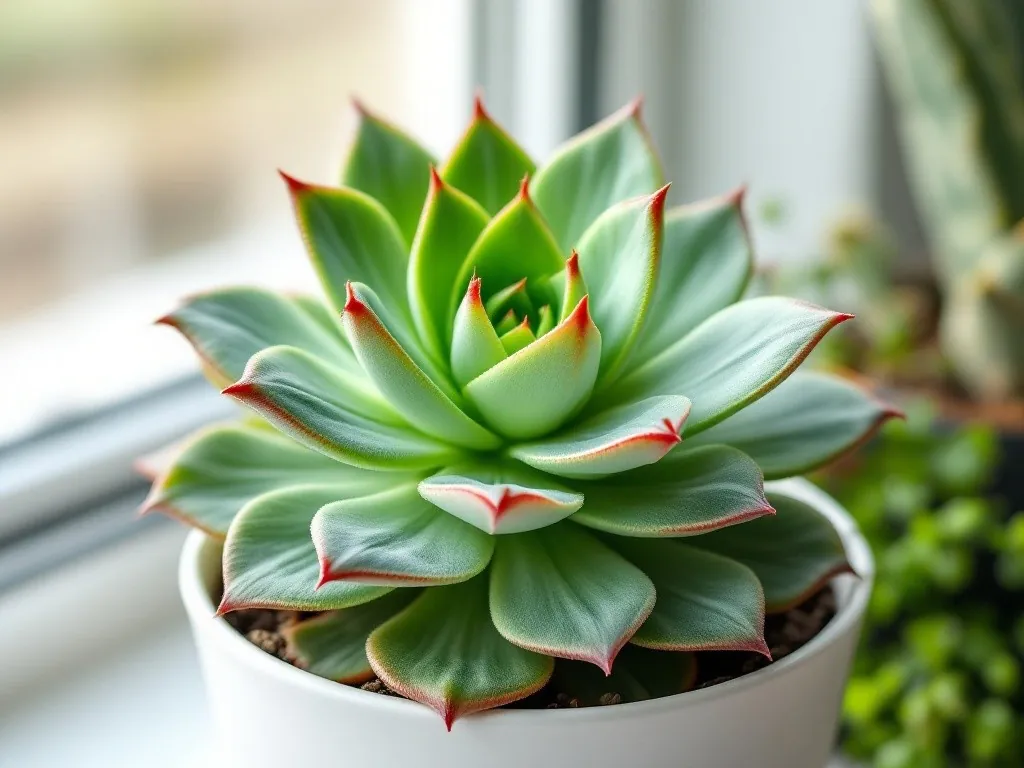
It forms a flat, globular rosette 5–12 cm across, built from fleshy, pointed leaves overlapping like roof tiles, with fine cilia along the margin. The leaf colour changes with conditions — in full sun and after cold spells the base and tips turn red or purple, while in shade the plant stays uniformly green and loses its compactness. From the sides of the rosette grow short stolons ending in ready-made daughter rosettes, which root quickly and form a dense carpet. In summer a mature rosette sends up a thick, leafy flowering stem up to 30 cm tall, topped by a flat, star-shaped inflorescence in shades of pink and red.
Growing and care
Watering
In the ground it requires practically no watering — rain is entirely sufficient. Water only in a container during prolonged drought. In winter it is not the temperature that is lethal but the wet: rosettes standing in sodden soil rot, even though they withstand -30 °C without harm.
Fertilizing
Fertilising is harmful: nitrogen forces the rosettes apart, robs them of their compact form and intense red colouring, and makes the plants susceptible to rot. The houseleek naturally grows on rocky scree with almost no humus.
Planting
An extremely free-draining substrate: sand, gravel, fine crushed stone, a minimum of humus. On heavy soils spread a layer of gravel beneath the rosettes. The rosette is pressed shallowly into the substrate and heaped round with gravel, so that the leaves do not lie on moist soil.
Pruning
Cut out the whole flowering stem together with the dying mother rosette at ground level and fill the resulting gap with offsets transplanted from the sides.
Companion plants
Good companions
A classic rock-garden pairing — both plants require full sun and a dry, free-draining substrate, and the stonecrop flowers in autumn, when the houseleek has already finished.
A drought-loving grass with identical soil requirements; its blue-grey tufts contrast well with the flat rosettes of the houseleek.
The same recipe for a position — full sun, dry and free-draining, rather alkaline soil; the houseleek nicely fills the space at the base of lavender clumps.
Bad companions
It requires shade and constantly moist soil — in such conditions the rosettes of the houseleek rot, and the broad leaves of the hosta shade them further.
They overgrow the low rosettes of the houseleek and keep moisture around them, which leads to rot — the houseleek has nothing to compete with, because it grows slowly.
The evidence level indicates whether the relationship is backed by research, observation, or gardening tradition.
Toxicity
| For whom | Level | Notes |
|---|---|---|
| Humans | None | A non-toxic plant; the juice of the fleshy leaves was traditionally applied externally to burns, insect bites and skin irritations, much like aloe. |
| Dogs | None | — |
| Cats | None | — |
History and origin
The specific name tectorum means “of the roof” and is no accident: in medieval Europe houseleeks were deliberately planted on thatched and shingled roofs in the belief that they protected the house from lightning — the plant was associated with Jupiter, and in Germanic tradition with Thor, the gods of thunder. Charlemagne, in the capitulary Capitulare de villis, ordered this plant to be grown on the imperial estates, which makes the houseleek one of the few ornamental plants with a written “planting order” from over a thousand years ago. It made practical sense too on dry, poor roofs: the dense carpet of rosettes stabilised the covering and retained water. In parallel, the juice of the leaves was used externally in folk medicine — for burns, warts and insect bites.
Uses
The fundamental plant for rock gardens, retaining walls, crevices between paving slabs, green roofs and dry, sunny banks, where it forms a durable, undemanding carpet. Excellent for flat bowls, troughs and containers on a sunny balcony and for gravel succulent compositions. Valued wherever what matters is a plant you can simply forget about.
Trivia
- The houseleek is monocarpic: a given rosette flowers exactly once in its life and dies after setting seed. This is not, however, the death of the whole plant — before it flowers, it becomes surrounded by a ring of offsets that take its place. The English name hen and chicks describes precisely this arrangement.
- The generic name Sempervivum means literally “always alive” — and it is apt twice over: the plants are evergreen, and thanks to constant renewal through offsets the clump practically never perishes, even though individual rosettes regularly die after flowering.
- In winter it is water, not frost, that threatens the houseleek. The rosettes survive -30 °C, but planted in heavy, sodden soil they rot even in a mild, rainy winter — which is why gravel is always spread beneath them.
Frequently asked questions
My houseleek has flowered and now the rosette is withering — is the plant ill?
No, this is entirely natural. The houseleek is a monocarpic plant: each rosette flowers only once in its life and dies after setting seed. The clump, however, does not perish, because the mother rosette has already put out numerous offsets on lateral stolons. After flowering it is enough to cut out the flowering stem with the dead rosette at ground level and fill the gap with the nearest “chicks”.
Will common houseleek survive winter in the ground and in a container on a balcony?
In the ground yes, and without any protection at all — it is one of the most frost-hardy succulents, tolerating zone 3a and frosts below -30 °C. It is killed not by frost but by winter wet, which is why a free-draining substrate and a layer of gravel beneath the rosettes are crucial. In a container the problem can be the root ball freezing right through and standing water, so it is worth placing the pot under the eaves and setting it on blocks so that excess water can drain away freely.
How do you propagate houseleek?
Most simply by offsets. During the season it is enough to cut or snap off the rooted daughter rosettes together with a fragment of the stolon and press them shallowly into a free-draining substrate — they establish almost one hundred per cent of the time, without rooting hormone or watering. Propagation from seed is possible but slow and used mainly by collectors, since the seedlings do not exactly repeat the colouring of the mother plant.
Sources
- Plants of the World Online (POWO)Database (GBIF, POWO…)
- RHS — Sempervivum tectorumInstitution / botanical garden
My note
A private note for this plant — saved in your browser.