In short
- Two types of frond: sterile shield fronds and fertile fronds (the “antlers”) — each performs a different function.
- The shield fronds turn brown over time — THIS IS NORMAL and they must not be removed.
- An epiphyte: grow it on a board, on bark or in a basket with moss, never in ordinary soil.
- It does not flower — it reproduces by spores gathering in brown patches at the tips of the “antlers”.
- Water by immersing the whole root ball in water for a quarter of an hour or so, not by pouring over it.
- Strictly a pot plant in the Polish climate; a bright position without direct sun.
Botanical data
- Family
- Polypodiaceae (Polypodiaceae)
- Height
- 0.4–0.9 m
- Width
- 0.4–1 m
- Habit
- Cascading
- Growth rate
- Slow
- Position
- Partial shade
- Soil
- Peaty, Humus-rich
- pH reaction
- pH 5–6.5
- Moisture
- Moderate, Moist
- Bloom
- —
- Hardiness
- —
- Propagation
- By division, From seed
Characteristics
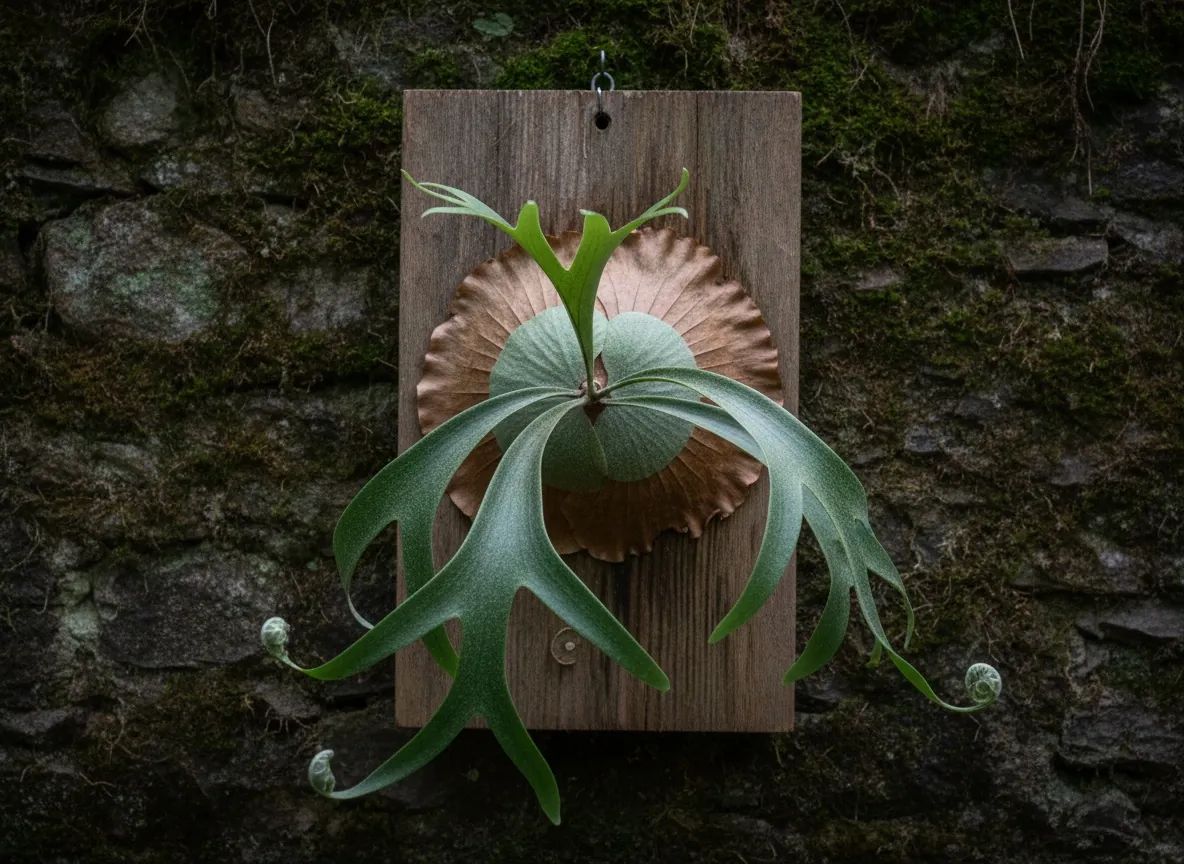
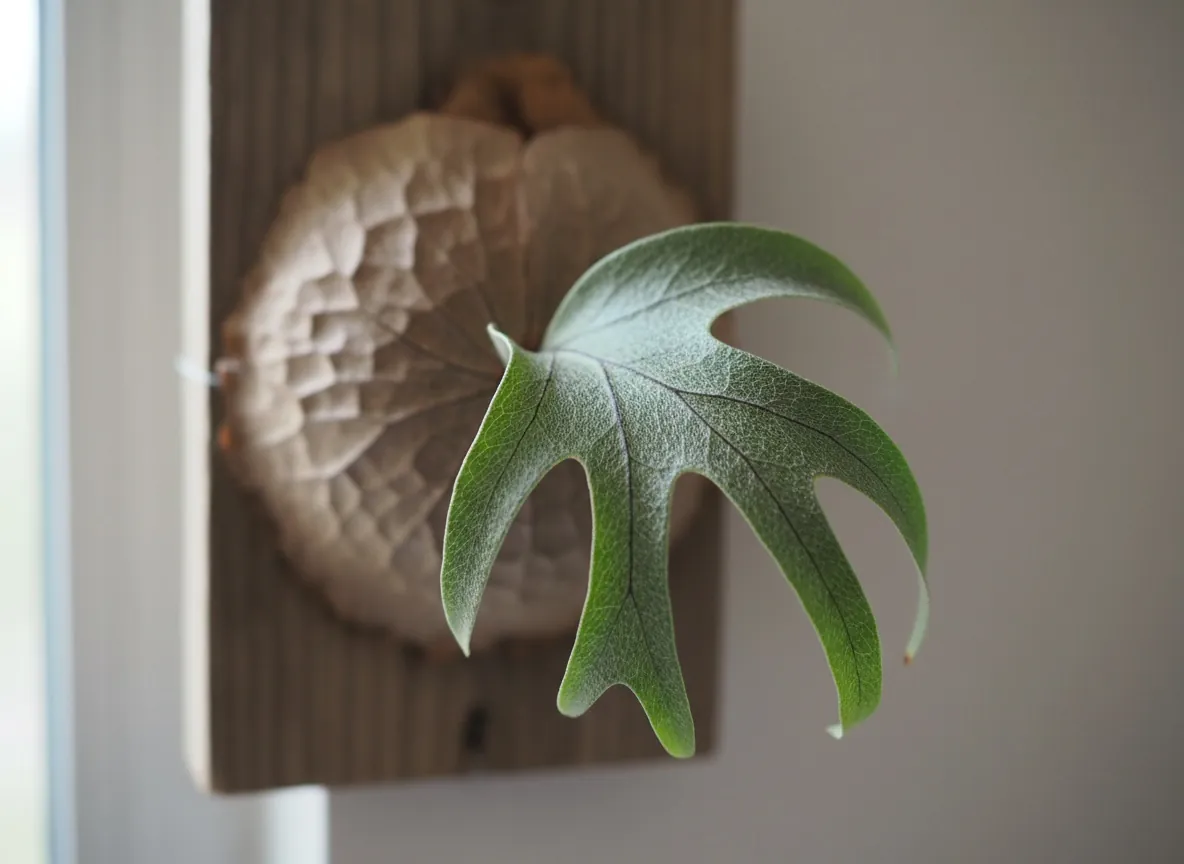
The plant has a structure that no other popular pot fern possesses: it produces two entirely different kinds of frond. The sterile shield fronds are rounded, flat and press against the substrate like a shield — green at first, they later turn brown and harden, forming overlapping layers that shelter the rhizome and roots and collect rainwater and falling organic debris in their pocket. The fertile fronds are pendulous, leathery, blue-green and forked — it is these that resemble a stag's antlers and gave the plant its name. Their surface is covered with fine, silvery hairs that limit evaporation. The sporangia gather in brown, velvety patches on the underside of the tips of the “antlers”.
Growing and care
Watering
You do not water “into the pot” — the whole ball (the board, basket or ball of moss) is immersed for 10–20 minutes in lukewarm, soft water, then drained. Between baths the substrate should dry out noticeably; permanently wet moss beneath the shield is the surest route to rotting the plant.
Fertilizing
Fertiliser dissolved in the bathing water, always at half the recommended concentration. Do not feed in winter.
Planting
Do not plant in ordinary soil. Wrap the root ball in sphagnum moss and fasten it to a board, bark or a piece of trunk with soft string or fishing line, with the shield pressed against the substrate. Alternatively a basket or pot with a very free-draining mix of bark, peat and sphagnum.
Pruning
Remove only fronds that are completely withered and those that are soft and blackened with rot.
Companion plants
Good companions
Also an epiphyte with an almost identical cultivation regime — a bath instead of watering, a free-draining bark substrate and diffuse light; both plants are looked after in the same way.
It tolerates the same diffuse light and helps raise the air humidity around the staghorn fern, while its trailing shoots compose well with the fern's antlers.
A plant with similar light and humidity requirements, creating in the composition the humid microclimate typical of the tropical forest understorey.
Bad companions
They require full sun and extremely dry air — in such conditions the fronds of staghorn fern yellow and wither.
As an epiphyte, staghorn fern needs the ball to dry out noticeably between baths — a permanently wet layer of moss leads to rotting of the rhizome.
The evidence level indicates whether the relationship is backed by research, observation, or gardening tradition.
Toxicity
| For whom | Level | Notes |
|---|---|---|
| Humans | None | — |
| Dogs | None | — |
| Cats | None | Regarded as a plant safe for pets — it contains no substances known to be toxic. |
History and origin
In the wild, staghorn fern sits high on the boughs of trees in the humid forests of eastern Australia, where it has no access to soil — its whole remarkable “two-frond” body plan is the answer to that challenge: the sterile shields act as a basket for humus and water, replacing soil for the plant. It reached Europe in the 19th century with the wave of fascination for exotic ferns and quickly became an ornament of orangeries. In the Anglosphere it is known as the staghorn fern; in Poland the colloquial name “róg jelenia” (stag's horn) is chiefly used.
Uses
An ornamental plant for bright interiors, especially striking mounted on a board and hung on the wall as a living picture. It also works well in hanging baskets and on shelves, where the pendulous fertile fronds have room to develop. Excellent for bright bathrooms and other rooms with raised air humidity.
Trivia
- The brown, “dead” shields at the base of the plant are not a sign of disease or neglect — they are a fully functional organ. Their dying off is by design: the layers of dry shields act as a basket collecting rainwater and humus, thus replacing the soil that simply does not exist on a tree bough.
- The silvery bloom on the fronds is not dust but a dense coat of very fine hairs protecting against water loss and harsh sun. Wiping the frond with a cloth removes this protection, which is why staghorn fern is never polished.
- The way it is grown is a hint from nature itself: the plant is fixed to a board and hung on the wall, exactly as it attaches to a bough in the wild — this lets the striking “antlers” hang freely.
Frequently asked questions
The lower fronds of my staghorn fern have turned brown — should I cut them off?
No. These are the sterile shield fronds, which by design turn brown and harden — that is when they perform their proper function: sheltering the rhizome and collecting water and humus, thus replacing soil for the plant. Tearing them off exposes the rhizome and weakens the fern. You may remove only fronds that are completely withered, blackened and soft with rot.
How do you correctly water a staghorn fern on a board?
By immersion. The whole ball with its moss is immersed in lukewarm, soft water for 10–20 minutes until the moss is saturated, then drained and hung back up. In summer usually once a week, in winter every two weeks — always only once the substrate has visibly dried out. Pouring water over the plant “from above” does not moisten the ball, and water standing in the pocket of the shields encourages rot.
What are the brown patches at the tips of staghorn fern fronds — is it a disease?
They are sporangia, that is, reproductive structures. Ferns do not flower and have no seeds — they reproduce by spores, and in staghorn fern these gather in velvety, brown patches on the underside of the tips of the “antlers”. Their appearance is a sign of a mature, healthy plant, not of infection, and they should be neither treated nor wiped off.
Sources
- Plants of the World Online (POWO)Database (GBIF, POWO…)
- RHS — Platycerium bifurcatumInstitution / botanical garden
My note
A private note for this plant — saved in your browser.