In short
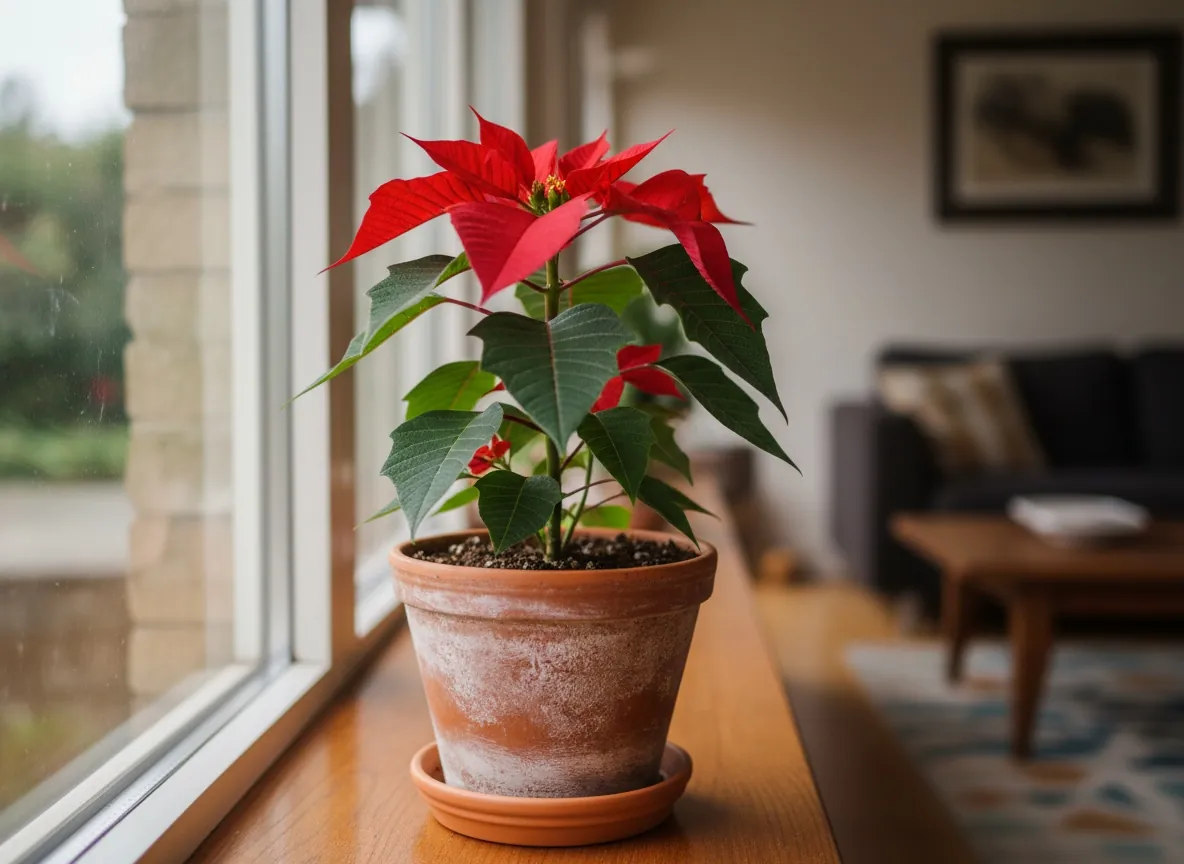
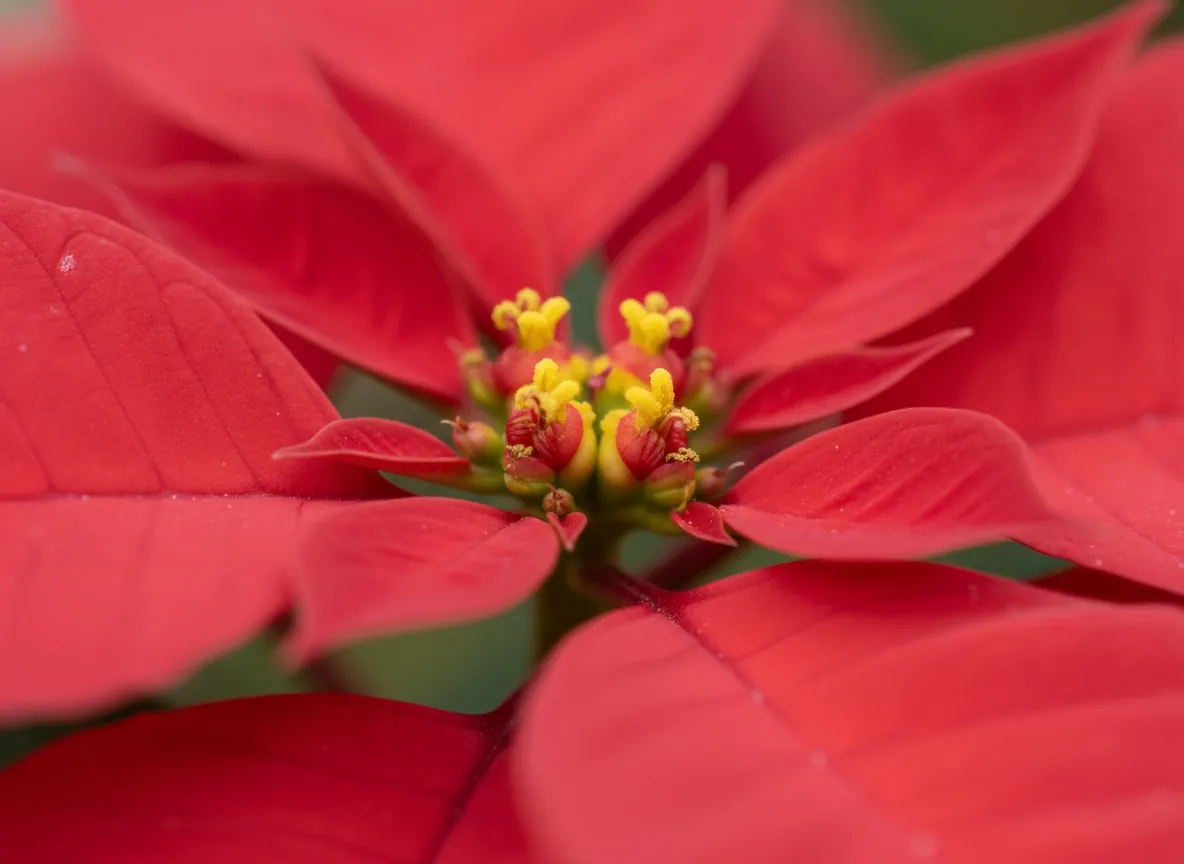
- The colourful “petals” are bracts (leaves), not flowers — the true flowers are yellow and inconspicuous.
- They only change colour if the plant receives 14 hours of complete darkness a day in autumn.
- A warm and bright position, without draughts; cold during the journey home from the shop is what most often kills it.
- Water sparingly and cut open the decorative foil — standing water loses the roots.
- The popular myth about deadly toxicity is untrue — the milky sap merely irritates.
Botanical data
- Family
- Euphorbiaceae (Euphorbiaceae)
- Height
- 0.3–0.6 m
- Width
- 0.3–0.5 m
- Habit
- Upright
- Growth rate
- Fast
- Position
- Full sun, Partial shade
- Soil
- Humus-rich, Peaty
- pH reaction
- pH 5.5–6.5
- Moisture
- Moderate
- Bloom
- November–February
- Hardiness
- —
- Propagation
- From cuttings
Characteristics
A shrub with shoots that are woody at the base and exude a white milky sap when damaged. In pot cultivation it is chemically restricted to 30-60 cm; in the wild and planted out in a warm climate it reaches 2-4 m. The leaves are dark green, ovate, often lobed. The true inflorescences, called cyathia, are small, yellow-green and gathered in the centre of the rosette; they are surrounded by a ring of large, brightly coloured bracts — red, pink, cream or marbled. After flowering the plant drops its leaves and enters dormancy.
Growing and care
Watering
Water with a small amount of lukewarm water once the top layer of substrate has dried out. The most common cause of death in Christmas specimens is water collecting in the decorative foil or cachepot — the foil must be cut open immediately after purchase and any excess water poured away.
Fertilizing
Do not fertilise while the bracts are recolouring or during flowering — resume feeding only after the spring pruning.
Planting
A free-draining peat substrate with perlite, in a pot only slightly larger than the previous one. A warm position (18-22 °C), without draughts and away from windows opened in winter.
Pruning
Shorten all the shoots to 10-15 cm above the substrate, leaving a few buds on each. The cuts bleed white sap — this can be stopped by spraying with lukewarm water or dusting with charcoal.
Companion plants
Good companions
Both plants are short-day plants and come into flower in winter under the same regime of long nights — they can be shaded together in autumn.
The same need for warmth, a bright position and protection from draughts; plus the contrast of the recoloured leaves of both species.
Bad companions
The fern requires constantly moist substrate and misting — under such watering the poinsettia quickly rots at the base of the shoots.
The evidence level indicates whether the relationship is backed by research, observation, or gardening tradition.
Toxicity
| For whom | Level | Notes |
|---|---|---|
| Humans | Mild | Contrary to widespread opinion, it is not a deadly poisonous plant. The white milky sap irritates the skin and eyes, and eating the leaves may cause nausea or vomiting — toxicological studies and data from poison centres record no cases of serious poisoning. |
| Dogs | Mild | Irritation of the mouth, drooling and vomiting; the symptoms are usually mild and pass on their own. |
| Cats | Mild | — |
History and origin
In Aztec culture the plant was known as cuetlaxochitl and used for dyeing fabrics and in medicine. It owes the name “poinsettia” to Joel Roberts Poinsett, the first US minister to Mexico, who sent cuttings to South Carolina in 1828. The plant's association with Christmas spread in the 20th century thanks to the Californian Ecke family, who mastered the production of compact, richly coloured pot cultivars.
Uses
A seasonal interior decoration for the Christmas period — for a windowsill, table or counter, provided it is away from draughts and cold panes. With a little patience it can be kept as a perennial houseplant and brought to recolour again the following year. Because of the irritating sap, keep it out of reach of small children and animals.
Trivia
- The belief in the deadly toxicity of the poinsettia stems from an unconfirmed 1919 account of a child's death after eating a leaf. Later toxicological studies and analyses of thousands of reports to poison centres have not shown a single case of serious poisoning — it is estimated that a child would have to eat several hundred leaves to exceed the toxic dose. The real problem remains the irritating milky sap, typical of the whole spurge family.
- The plant is a short-day plant: the recolouring of the bracts is triggered not by cold or by fertilising, but by the length of the night. The light of a street lamp, or a lamp switched on in the evening in the same room, is enough to interrupt the autumn regime of darkness and produce, by Christmas, a plant with entirely green leaves.
Frequently asked questions
How do I make a poinsettia turn red again?
It is the length of the night that decides, not fertilising. The poinsettia is a short-day plant: from the end of September, for about 8-10 weeks, it must have at least 14 hours of complete darkness a day (for example from 18:00 to 8:00) and 10 hours of bright light, at 18-20 °C. In the evening cover it with a box or move it into a dark room. Any accidental light — a street lamp outside the window, a television, a lamp left on — interrupts the process and the bracts will stay green.
Is the poinsettia poisonous to children and cats?
Not in the way the popular myth claims. The white milky sap irritates the skin and eyes, and eating the leaves causes at most nausea, vomiting, or irritation of the mouth in animals. Data from poison centres do not confirm any cases of serious or fatal poisoning. Even so, it is better to place the plant out of reach of children and animals, and to wash your hands after pruning.
Why is my poinsettia dropping its leaves right after purchase?
This is usually the result of thermal shock on the way home from the shop (a dozen or so minutes below 10 °C is enough) or of water standing in the decorative foil. Buy plants packed in a protective sleeve, cut the foil open as soon as you get home, place the pot in a warm, bright spot without draughts, and water sparingly with lukewarm water.
Sources
- Plants of the World Online (POWO)Database (GBIF, POWO…)
- Missouri Botanical Garden — Euphorbia pulcherrimaInstitution / botanical garden
My note
A private note for this plant — saved in your browser.