In short
- A bright position, but without harsh midday sun — an east- or west-facing window.
- Water only after the substrate has dried out; the fleshy leaves store water.
- Do not cut off spent inflorescences — it flowers on them again in subsequent years.
- A tight pot and a cooler winter rest encourage the setting of flowers.
- The flowers exude sweet nectar and are strongly fragrant in the evening.
Botanical data
- Family
- Apocynaceae (Apocynaceae)
- Height
- 1.5–4 m
- Width
- 0.4–1 m
- Habit
- Cascading
- Growth rate
- Moderate
- Position
- Full sun, Partial shade
- Soil
- Humus-rich, Peaty
- pH reaction
- pH 6–7
- Moisture
- Dry, Moderate
- Bloom
- May–September
- Hardiness
- —
- Propagation
- From cuttings, By layering
Characteristics
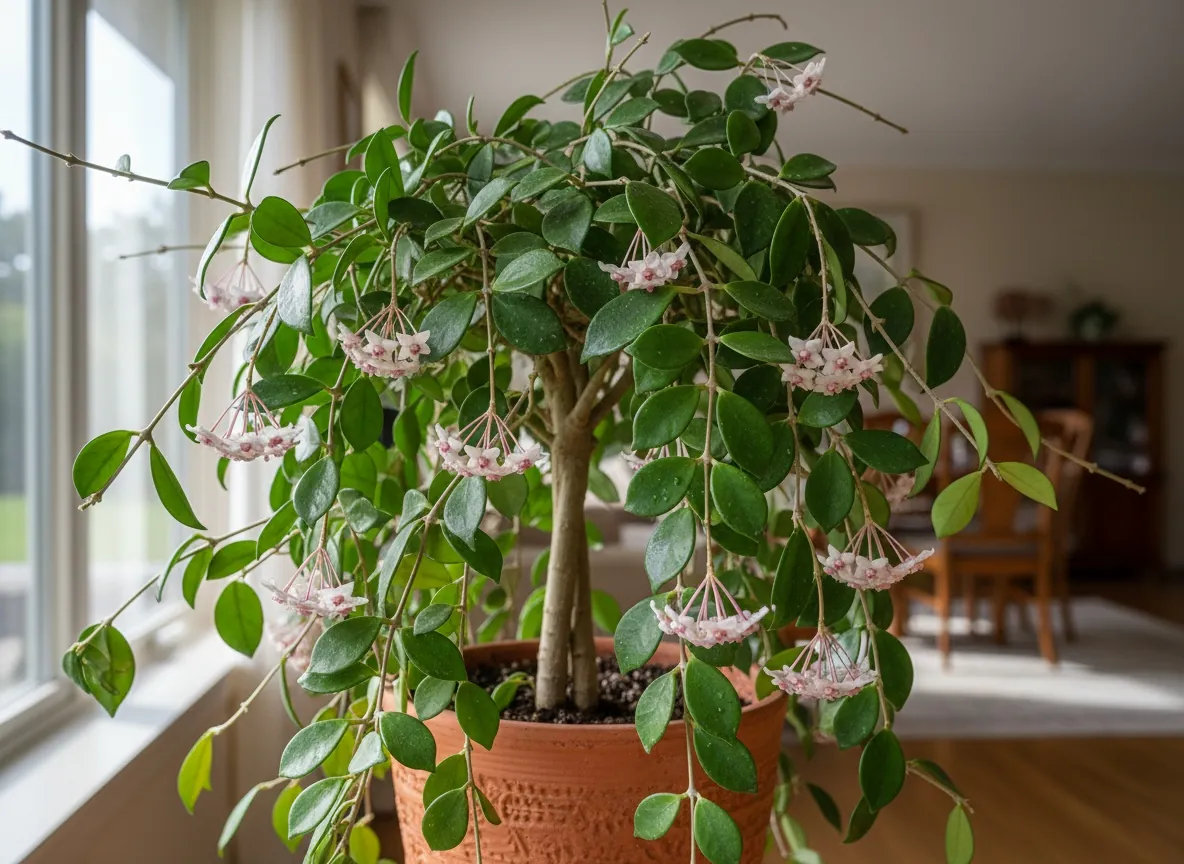
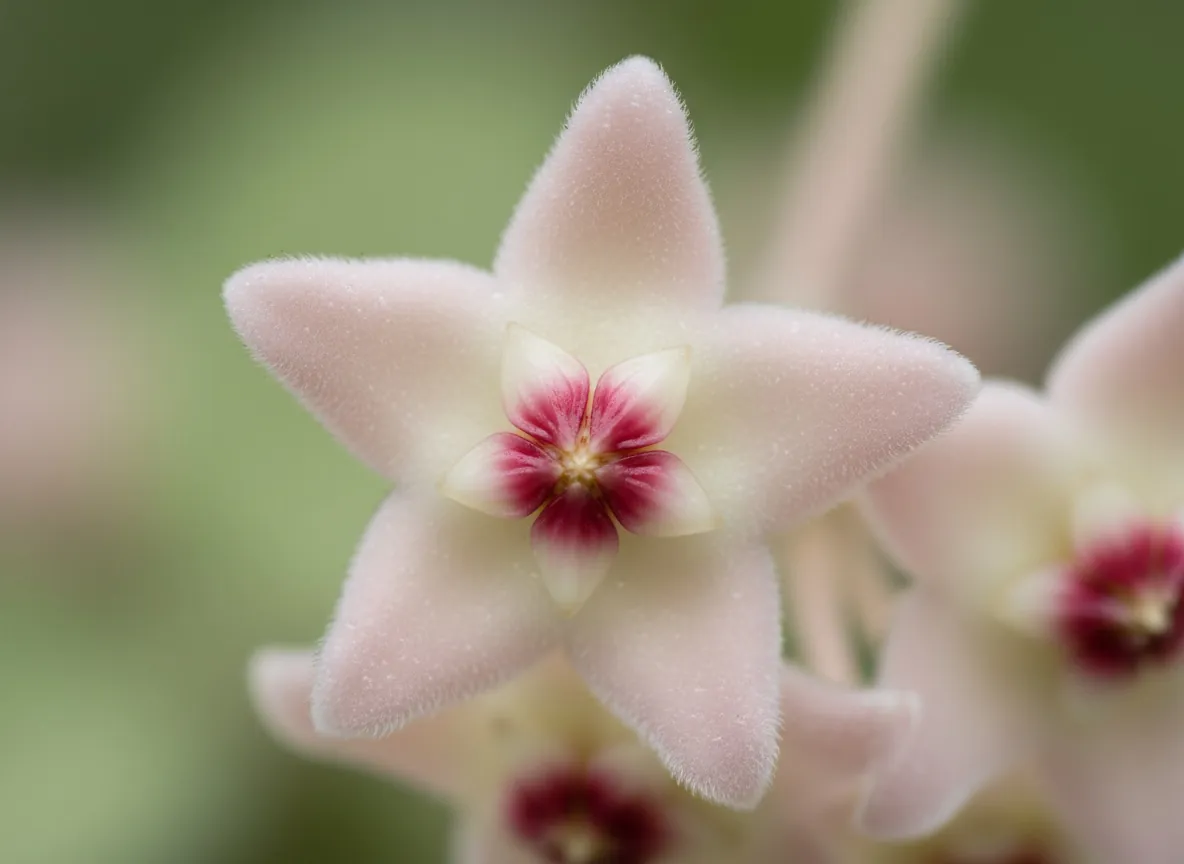
A perennial climber with shoots woody at the base, reaching 2-4 m in cultivation, usually trained around a hoop or trellis. The leaves are opposite, thick, stiff and glossy, dark green, sometimes silvery-speckled. The flowers are gathered in groups of a dozen or more in hemispherical umbels: five-pointed, white-pink stars with a darker, glossy corona in the centre, exuding nectar abundantly.
Growing and care
Watering
Thick, fleshy leaves store water — water only after the substrate has dried out to half its depth. In winter, in a cooler room, practically stop watering. Overwatering ends in root rot and leaf drop.
Fertilizing
A weak concentration; avoid high-nitrogen fertilisers — they produce lush shoots at the expense of flowers.
Planting
A well-drained epiphytic mix: peat substrate with pine bark, perlite and a little charcoal. A tight pot encourages flowering; a support or hoop is needed to train the shoots.
Pruning
Shorten excessively elongated shoots just above a node; remove only dried or damaged shoots.
Companion plants
Good companions
Both are epiphytes with the same needs — bright diffused light and drying of the substrate between waterings.
Similarly sparing watering and tolerance of dry indoor air — an easy shared care regime.
Bad companions
The prayer plant requires a constantly moist substrate and partial shade; with such watering the hoya's roots rot, and in shade it stops flowering.
The evidence level indicates whether the relationship is backed by research, observation, or gardening tradition.
Toxicity
| For whom | Level | Notes |
|---|---|---|
| Humans | Mild | Damaged shoots exude a white milky sap which in sensitive people may irritate the skin and eyes. It is worth putting on gloves when pruning. |
| Dogs | None | — |
| Cats | None | The hoya is counted among the plants non-toxic to pets; only contact with the milky sap can be irritating. |
History and origin
The genus was named after Thomas Hoy, the 18th-century English gardener to the Duke of Northumberland. The species reached European glasshouses at the end of the 18th century and became one of the classic plants of grandmothers' windowsills — specimens passed down in families can flower for decades.
Uses
For bright interiors — on the sill of an east-facing window, in a hanging planter or trained around a hoop or trellis. It does well in rooms poorly heated in winter and with people who water irregularly.
Trivia
- The flowers exude so much nectar that in abundant flowering it can drip from the umbels and leave sticky traces on the windowsill and leaves.
- The inflorescences grow from short shoots known as spurs — the same spur flowers year after year, which is why an old, “ugly bare stick” without leaves is in fact the most valuable part of the plant.
Frequently asked questions
Why is my hoya not flowering?
The most common causes are too little light, too large a pot, or cutting off the previous year's inflorescences. Place the plant in a bright spot without harsh sun, do not repot it “just in case”, and let it overwinter cooler (15-18°C), watering sparingly.
Should the hoya's spent flowers be cut off?
No. The dried flowers will drop by themselves, but the short shoot (the spur) on which they grew must be left — in subsequent seasons the next umbel will flower from it. Cutting off the spurs is the most common reason why a hoya stops flowering.
Is the hoya toxic to cats?
Hoya carnosa is regarded as a non-toxic plant for cats and dogs. Damaged shoots do, however, exude a white milky sap which may irritate the skin or muzzle, so it is better to keep it out of reach of animals that like to chew leaves.
Sources
- Plants of the World Online (POWO)Database (GBIF, POWO…)
- RHS — Hoya carnosaInstitution / botanical garden
My note
A private note for this plant — saved in your browser.