In short
- A bright position with diffused light — harsh sun yellows the leaves.
- Keep the substrate constantly slightly moist; water with soft, settled water.
- Brown leaf tips usually mean hard water, drying out or dry air.
- Non-toxic to dogs and cats.
- Do not cut the stems or the tips — the palm does not break again after such pruning.
Botanical data
- Family
- Arecaceae (Arecaceae)
- Height
- 1.5–3 m
- Width
- 0.8–1.5 m
- Habit
- Clump-forming
- Growth rate
- Moderate
- Position
- Full sun, Partial shade
- Soil
- Humus-rich, Peaty
- pH reaction
- pH 5.5–6.5
- Moisture
- Moist, Moderate
- Bloom
- —
- Hardiness
- —
- Propagation
- From seed, By division
Characteristics
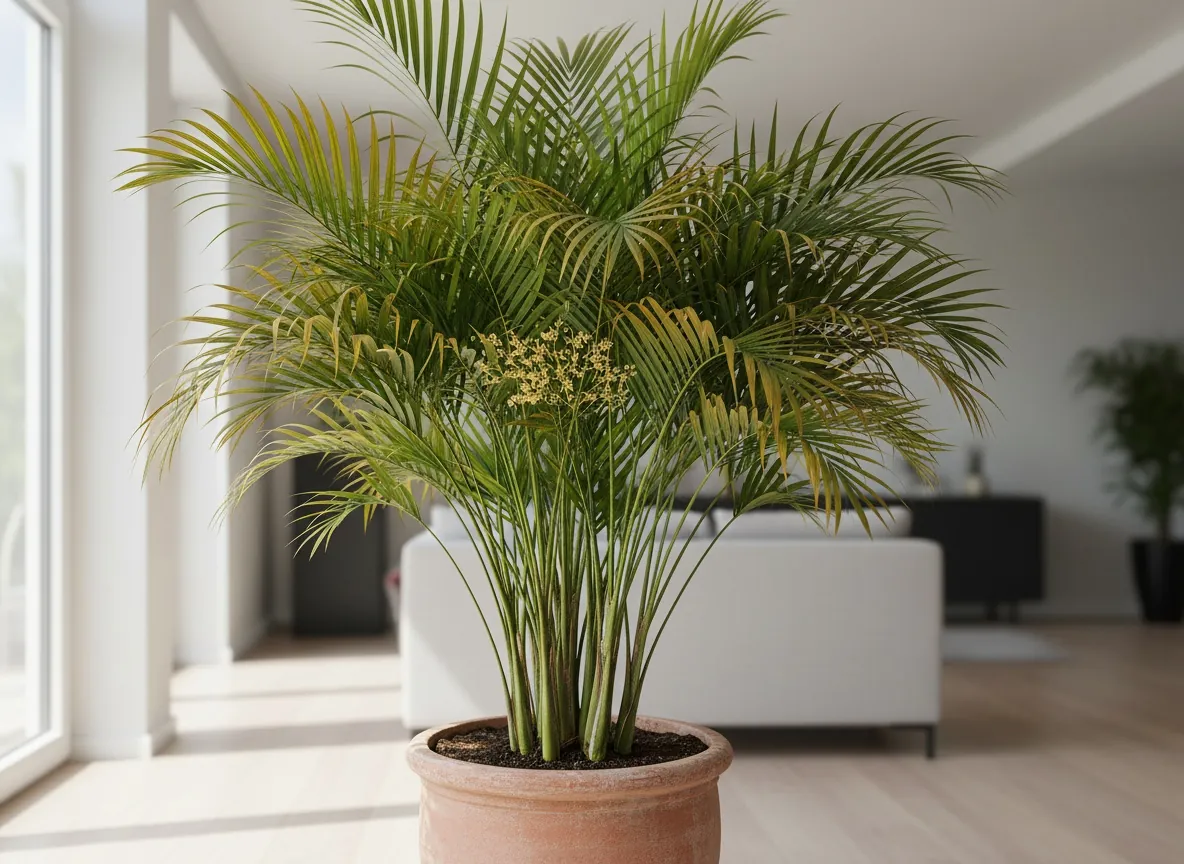
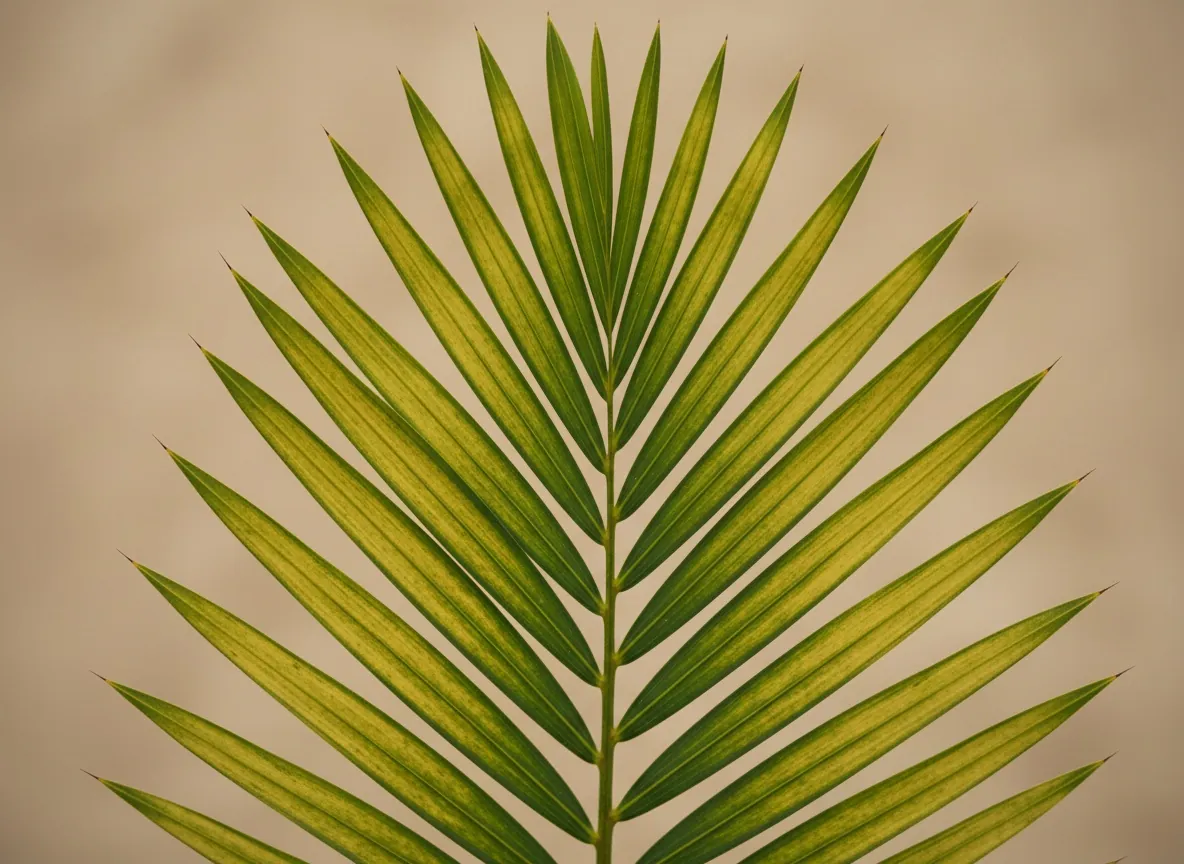
A clump-forming palm producing a bundle of slender, yellow-green stems with distinct, ring-like leaf scars resembling bamboo canes. The leaves are pinnate, arching, 1-2 m long, with several dozen narrow leaflets on each side of the axis. Indoors it reaches 1.5-3 m and practically never flowers; in the wild it produces yellow inflorescences and small fruits ripening from yellow to purple-black.
Growing and care
Watering
The substrate should remain slightly moist — drying out shows immediately in browning leaf tips. Sensitive to fluoride and to salts from fertilisers and hard water; water with settled or rainwater and always empty the saucer.
Fertilizing
A weak concentration — the areca tolerates a salty substrate poorly. Once a season it is worth flushing the root ball with a generous amount of soft water to wash out the salts.
Planting
A free-draining palm substrate with added sand and perlite; a tall, stable pot. Palms tolerate root disturbance poorly — repot by moving the whole root ball across, without breaking it up.
Pruning
Cut out only completely dried-out leaves, cutting the stalk a few centimetres above the stem.
Companion plants
Good companions
Both plants are safe for animals and have similar requirements — bright diffused light and regular watering.
The fern likes the same humid microclimate and, placed at the base of the palm, screens the bare bases of the stems and raises the humidity of the air.
Bad companions
The succulent requires the substrate to dry out completely, while the areca does not forgive drying out — a shared watering regime harms one plant or the other.
The evidence level indicates whether the relationship is backed by research, observation, or gardening tradition.
Toxicity
| For whom | Level | Notes |
|---|---|---|
| Humans | None | — |
| Dogs | None | — |
| Cats | None | The areca appears on lists of plants non-toxic to cats and dogs — one of the safest large plants for a home with animals. |
History and origin
The species was described from Madagascar, where it occurs naturally over only a small area of the east coast. In the 20th century it became one of the most widely produced pot palms in the world — first in the glasshouses of Europe, later in mass production in Florida and South-East Asia.
Uses
For bright living rooms, offices, halls and waiting rooms as a large structural plant or a soft, green screen separating zones of a room. Safe for homes with children and animals. In summer it can be moved out onto a sheltered terrace in partial shade.
Trivia
- It is one of the most paradoxical cases in botany: the areca palm grows in millions of homes and offices around the world, while in its homeland in Madagascar only a few dozen wild specimens have survived and the species is classed as critically endangered.
- The areca palm made it onto the list of plants studied by NASA for air purification in the 1980s. Results from hermetically sealed laboratory chambers are sometimes over-interpreted in advertising — in a normal, ventilated room the filtering effect is negligible, and the palm's real advantage lies rather in humidifying the air.
Frequently asked questions
Why are the leaves of my areca palm turning brown at the tips?
Most often because of hard tap water (the areca is sensitive to fluoride and salts), a dried-out root ball, or dry air next to a radiator. Water with settled or rainwater, do not let the substrate dry out completely, and raise the humidity. Brown tips cannot be reversed — they can be trimmed back gently, but do not remove whole leaves.
Is the areca palm safe for cats and dogs?
Yes, the areca palm appears on lists of plants non-toxic to cats and dogs. It is one of the few large, striking plants that can be placed in a home with animals without concern. Note: it should not be confused with the sago palm (Cycas), which is strongly poisonous.
Can an areca palm that has grown too tall be pruned?
No. Each stem of the palm grows from a single terminal growing point — once that is cut off, the stem dies and will not break again. Height is regulated only by removing the oldest, dried-out stems at ground level or by dividing the clump when repotting.
Sources
- Plants of the World Online (POWO)Database (GBIF, POWO…)
- Missouri Botanical Garden — Dypsis lutescensInstitution / botanical garden
My note
A private note for this plant — saved in your browser.