In short
- Strongly EXPANSIVE — in a small garden pond it takes over the entire marginal zone in 2–3 seasons.
- Plant only in baskets that restrict the rhizomes, or straight away in large, naturalistic bodies of water.
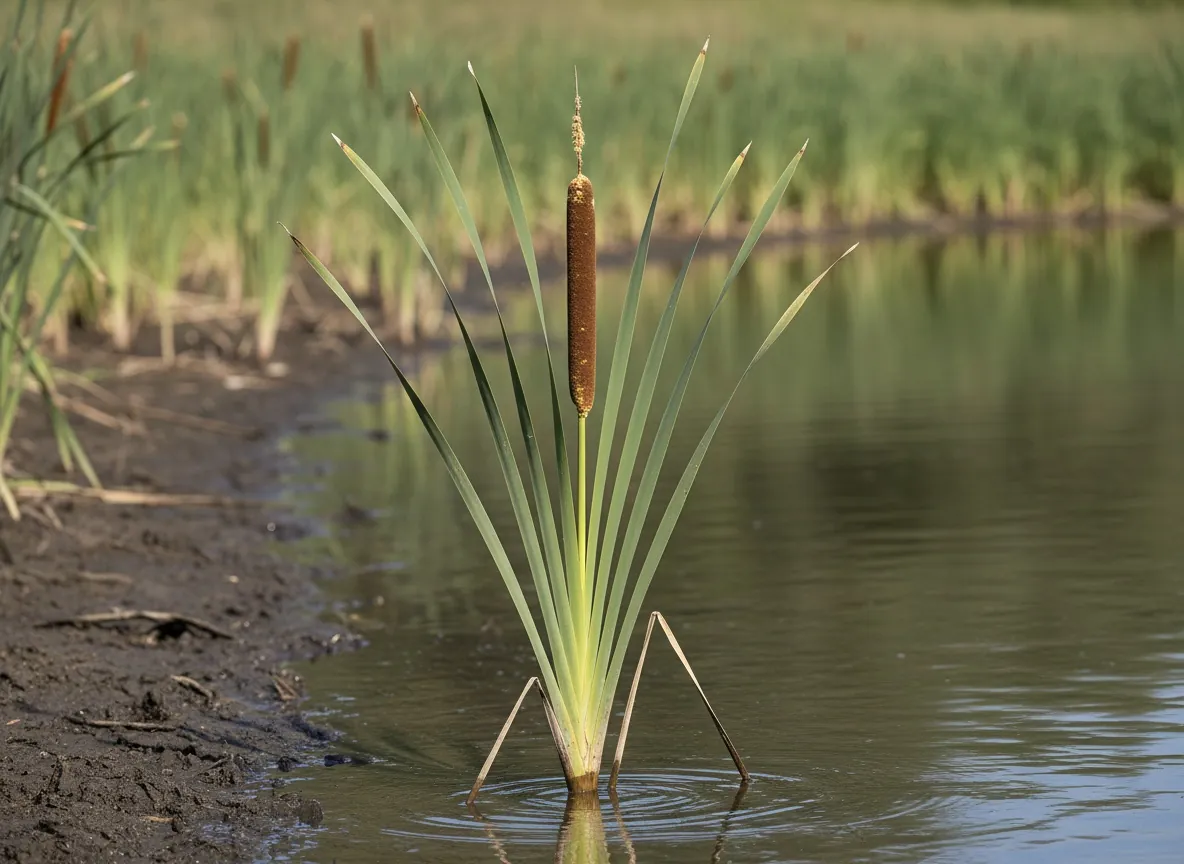
- The brown “cob” is the dense female inflorescence; the finer male one sits just above it on the same stem and soon drops off.
- It grows in shallow water (roughly 10–40 cm) or in permanently wet soil; it does not tolerate drying out.
- Very frost-hardy and practically maintenance-free — the problem is restraining it, not keeping it alive.
- High natural value: shelter and a nesting site for waterfowl, natural filtration of the water.
Botanical data
- Family
- Typhaceae (Typhaceae)
- Height
- 1.5–2.5 m
- Width
- 0.6–1.5 m
- Habit
- Upright
- Growth rate
- Fast
- Position
- Full sun, Partial shade
- Soil
- Loamy, Clay, Peaty, Humus-rich
- pH reaction
- pH 5.5–8
- Moisture
- Wet, Moist
- Bloom
- June–August
- Hardiness
- USDA 3a–10a
- Propagation
- By division, By runners, From seed
Characteristics
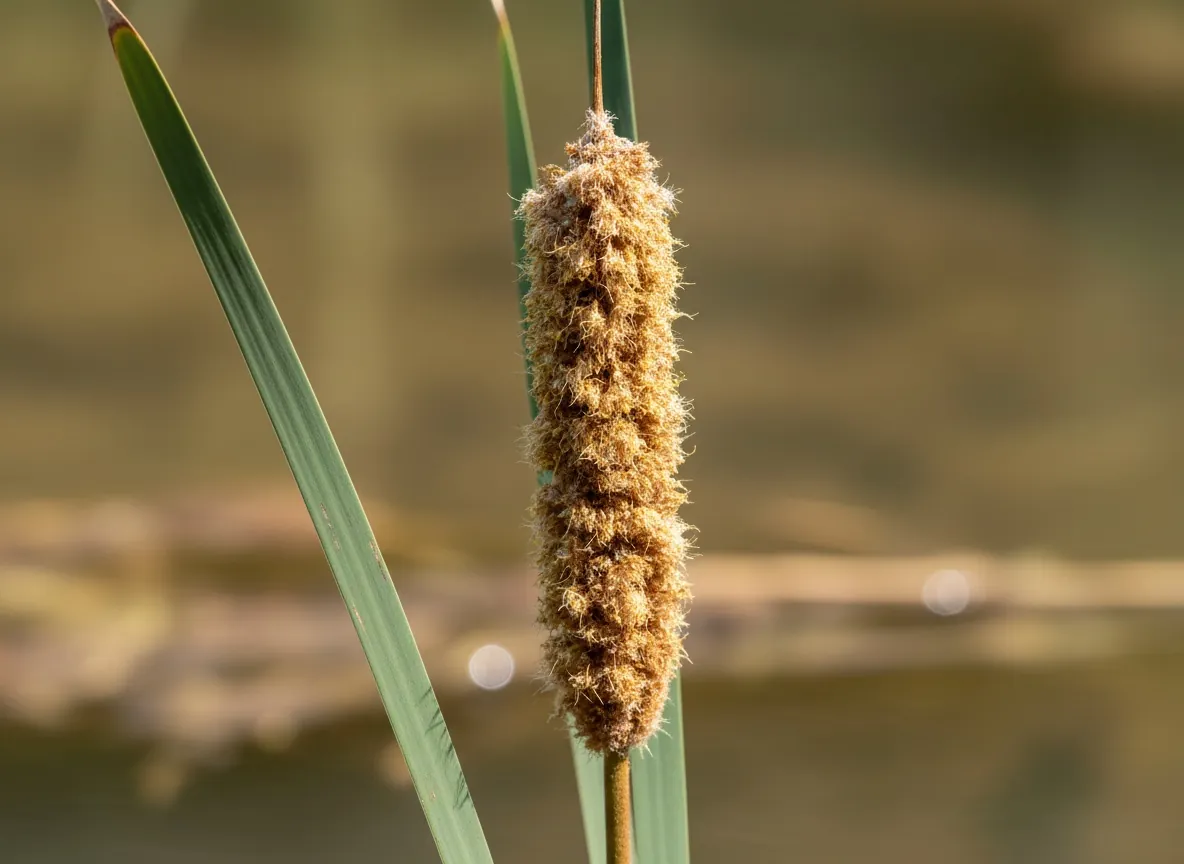
The plant grows from a thick, creeping rhizome that sends up new shoots each season — hence its tendency to form dense, single-species stands. The leaves are strap-shaped, stiff, upright, 1–3 cm wide (the broadest among the native cattails) and grey-green. The inflorescence is a cylindrical, dark brown “cob”, velvety to the touch, 10–25 cm long, composed of thousands of tiny female flowers; directly above it, on the same stem, sits the narrower and paler male inflorescence, which withers and drops after shedding its pollen, leaving a bare section at the top of the stem. In autumn the “cob” loosens and breaks up into a cloud of down carrying the seeds.
Growing and care
Watering
It grows in shallow water or in soil permanently saturated with it, and cannot be overwatered. In a container outside the pond the water level must constantly reach above the surface of the substrate — drying out of the root ball quickly causes the leaves to wither.
Fertilizing
In a natural, fertile pond, fertilising is unnecessary and even harmful — cattail grows very vigorously anyway, and an excess of nutrients in the water encourages algae.
Planting
The marginal zone or shallows with a water depth of roughly 10–40 cm above the substrate. In the garden plant ONLY in a strong basket or a sealed container restricting the rhizomes, filled with heavy clay soil and weighed down with gravel — planted directly into the bottom it will grow through the entire bank in a few seasons.
Pruning
Cut out withered leaves and inflorescences above the water surface, and every 2–3 years lift the basket and cut back the overgrown rhizomes with a spade or saw. Remove the inflorescences before the seed down disperses, if you do not want seedlings throughout the pond.
Companion plants
Good companions
They occupy entirely different zones of the pond — the cattail the marginal belt, the water lily the deep zone — so they do not compete directly, and the cattail shelters the water surface from wind, which benefits the water lily.
An equally vigorous marginal plant with similar requirements — in a large, naturalistic pond they together form a dense reed bed giving shelter to waterfowl.
Bad companions
The low marsh marigold occupies the same marginal belt but grows much more slowly — the cattail quickly shades it out and displaces it with its rhizomes.
Both plants spread by rhizomes in the same shallow zone; in immediate proximity the taller and faster cattail almost always gains the upper hand over sweet flag.
The evidence level indicates whether the relationship is backed by research, observation, or gardening tradition.
Toxicity
| For whom | Level | Notes |
|---|---|---|
| Humans | None | The plant is not toxic; its rhizomes were formerly used as food. Beware, however, of the sharp leaf edges, on which it is easy to cut yourself, and of the fact that plants from polluted waters accumulate heavy metals. |
| Dogs | None | — |
| Cats | None | — |
History and origin
The cattail has accompanied humankind for millennia. Its long, flexible leaves were a fundamental weaving material in Europe and Asia — from the “rush” people wove mats, baskets, cords and chair seats, and dry leaves were used to seal barrels. The rhizomes, rich in starch, were sometimes famine food, while the seed down was used to fill pillows and life jackets, among other things on a large scale during the Second World War. Today the species has gained a new role: it is one of the fundamental plants of constructed wetlands, where it takes up excess nitrogen and phosphorus from the water.
Uses
A plant for large, naturalistic ponds, retention basins and domestic constructed wetlands, where it is valued for its rate of growth, its stabilising of the bank with a dense network of rhizomes, and its capture of nutrient compounds from the water. In a small pond it makes sense only as a structural plant in a strong container restricting the rhizomes — its vertical leaves and characteristic cobs give an effect no other marginal plant can replace, but without control it quickly turns the pond into a reed bed.
Trivia
- The brown “cigar” is in fact thousands of tightly packed female flowers — a single inflorescence can produce over 200,000 seeds, and each of them floats through the air on its own tuft of down.
- Broadleaf cattail is most easily told from the narrowleaf species (Typha angustifolia) by the fact that in the broadleaf the male inflorescence adjoins the female directly, whereas in the narrowleaf a distinct gap on the stem separates them.
- Cattail rhizomes can lengthen by several dozen centimetres in the course of a single season — this is the main reason why it is planted only in a container in a garden pond.
Frequently asked questions
Can broadleaf cattail be planted in a small garden pond?
Yes, but only in a strong basket or a sealed container restricting the rhizomes, set in the shallows. Planted directly into the bottom it will take over the whole marginal zone in two or three seasons and displace the remaining plants. For ponds under a few square metres, narrowleaf cattail or the smaller dwarf cattail (Typha minima) is the safer choice.
What are the brown “cobs” of cattail?
They are the female inflorescences — cylindrical clusters of thousands of tiny flowers. The male inflorescence grows just above them on the same stem, is narrower and paler, and after shedding its pollen it quickly withers and drops, which is why in summer you see only the brown cob with a bare section of stem above it. In autumn the cob breaks up into down that carries the seeds.
How do you restrain a cattail that has taken over a pond?
The most effective method is digging out the rhizomes mechanically — merely cutting the leaves achieves nothing, since the plant regrows from its underground runners. It also helps to mow the shoots just below the water surface at the height of the season, repeated over 2–3 years, which gradually exhausts the reserves of the rhizome. It is worth cutting off the inflorescences before the down disperses, to limit self-seeding.
Sources
- Plants of the World Online (POWO)Database (GBIF, POWO…)
- USDA PLANTS Database — Typha latifoliaInstitution / botanical garden
My note
A private note for this plant — saved in your browser.