In short
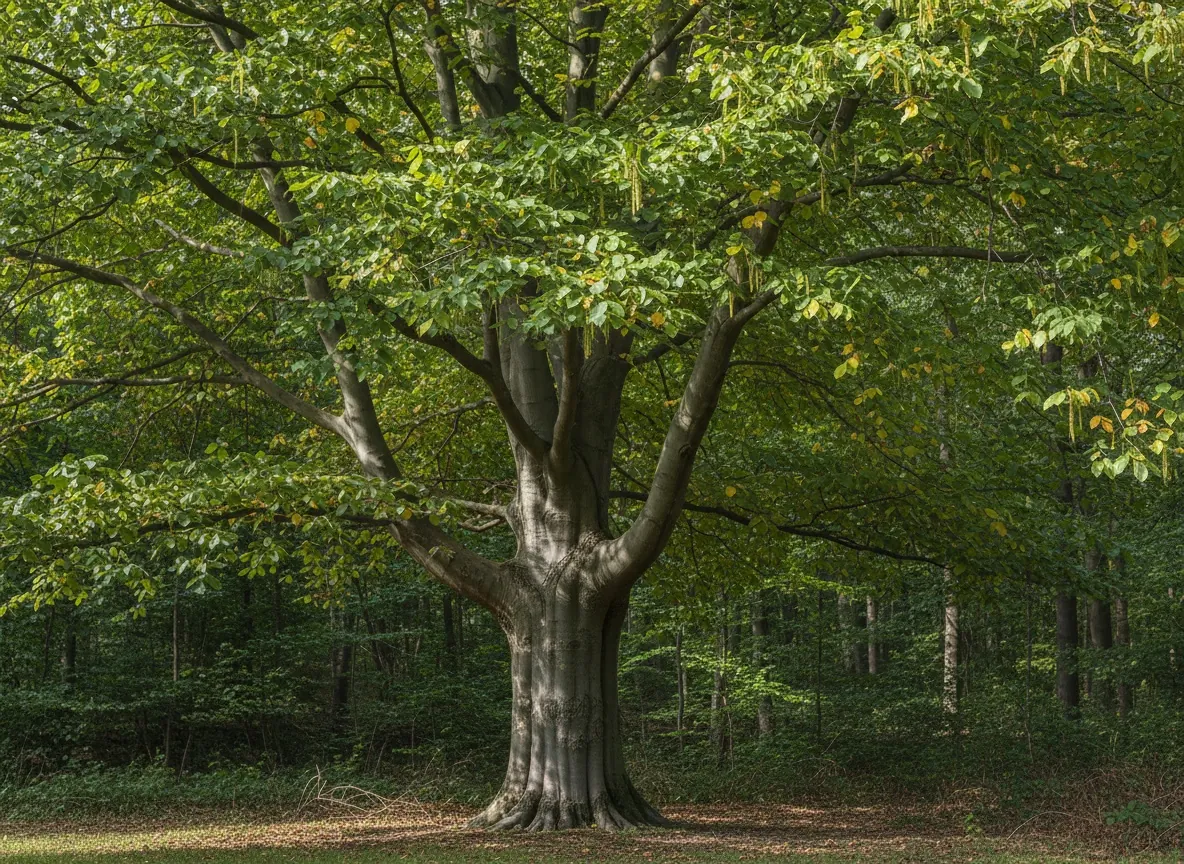
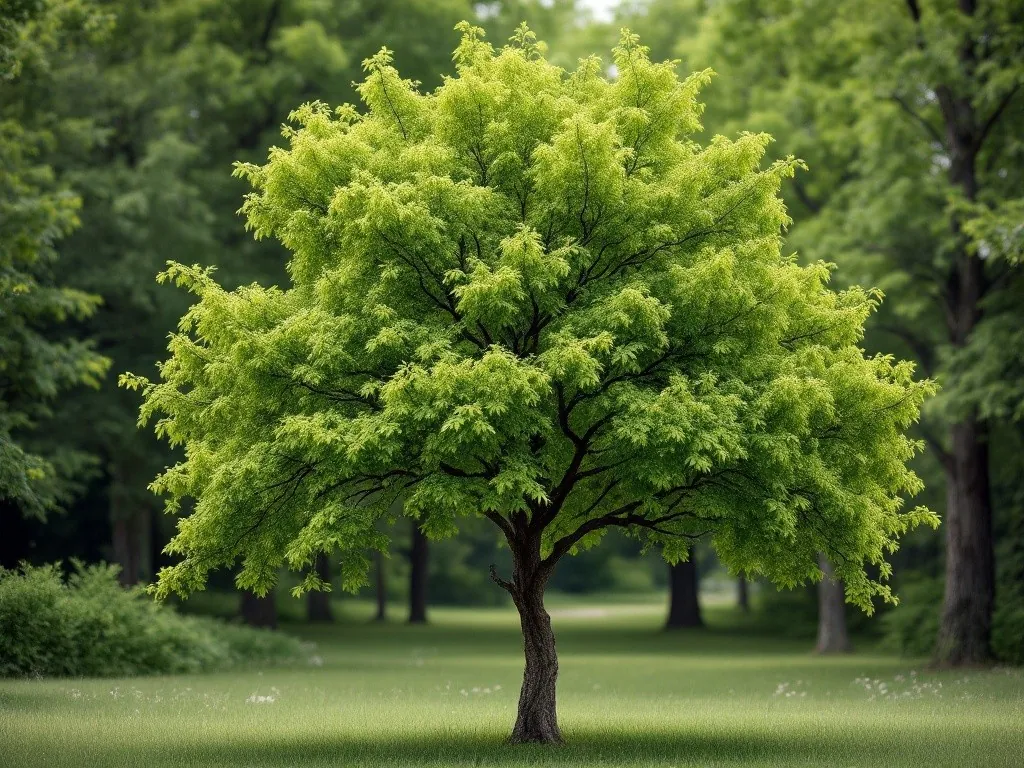
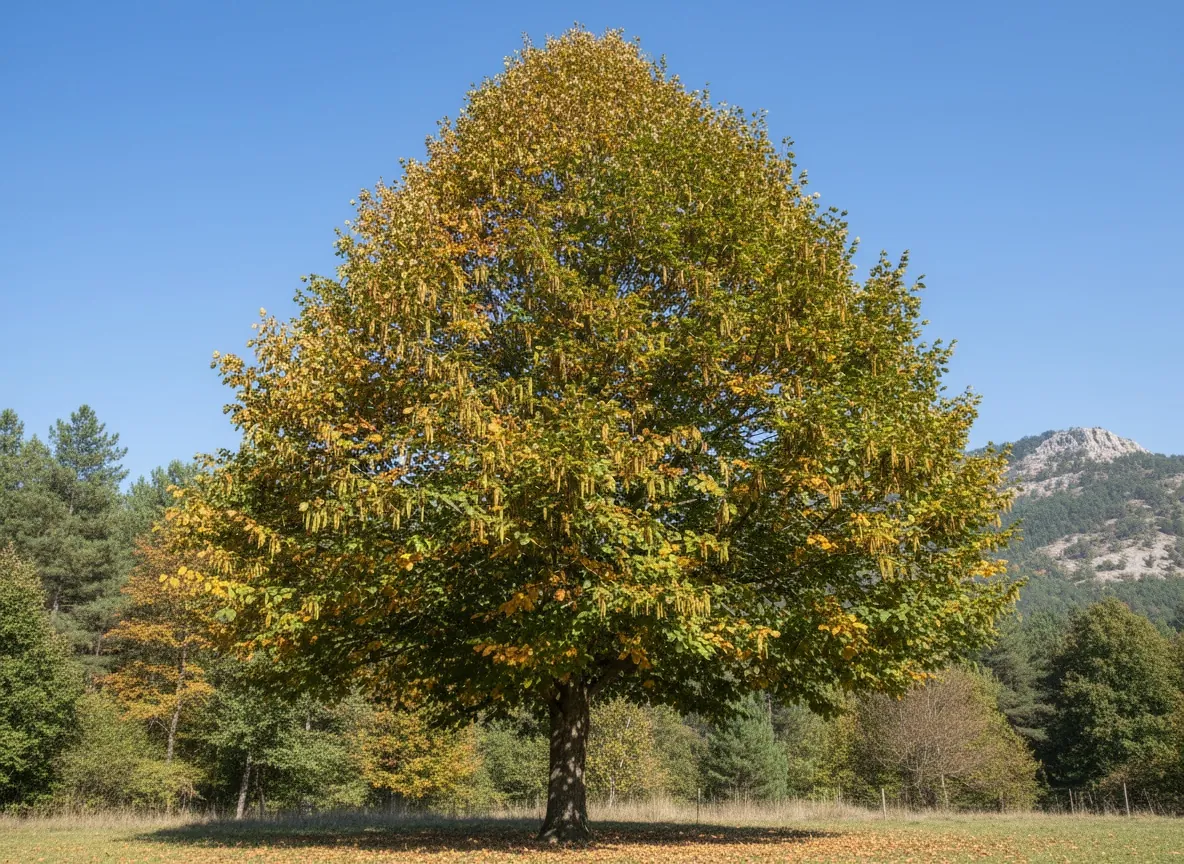
- Unlike the shrubby common hazel it grows as a tree with a single trunk and a regular, conical crown, reaching 15–20 m.
- Very resistant to drought, salinity, alkaline soils and air pollution — hence its popularity in avenues, car parks and city squares.
- It has a taproot, which does not lift pavement surfaces; this does, however, make transplanting older specimens difficult.
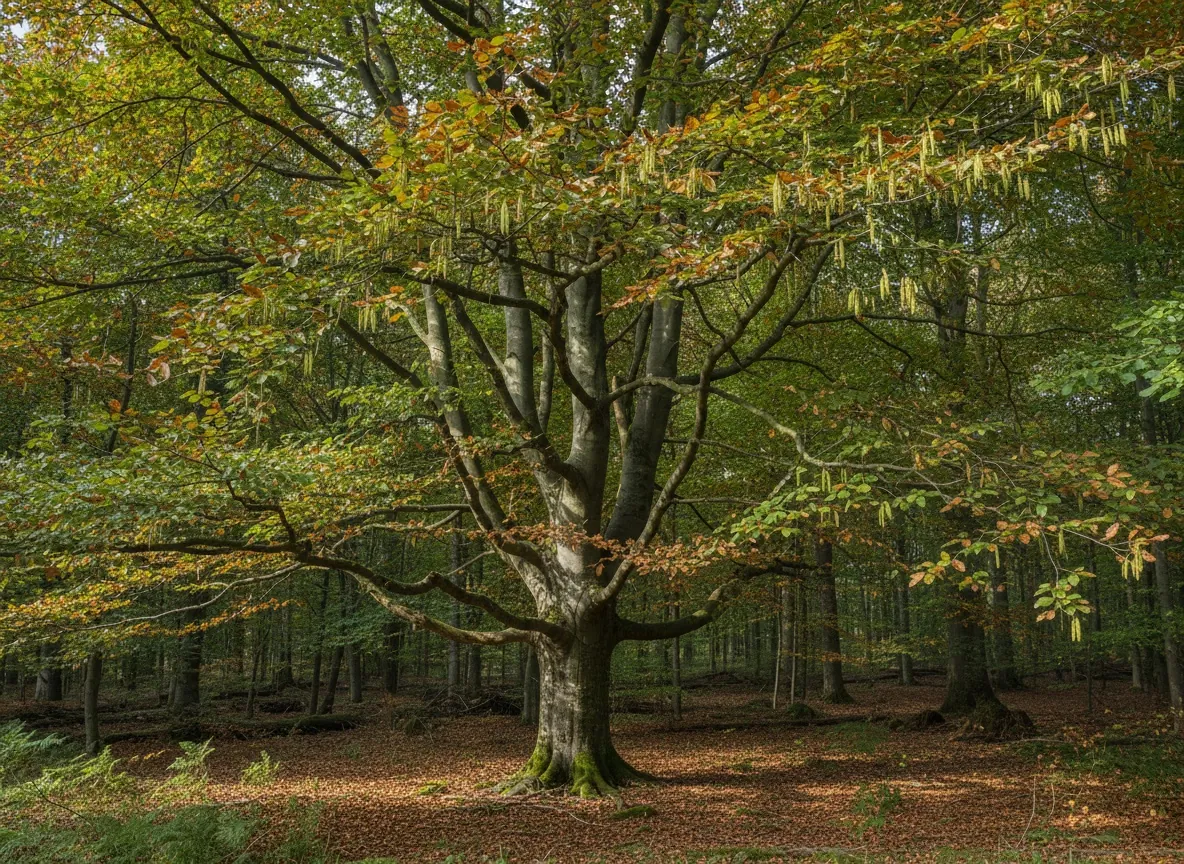
- Flowers very early (February–March) with hanging, yellow catkins, long before the leaves emerge.
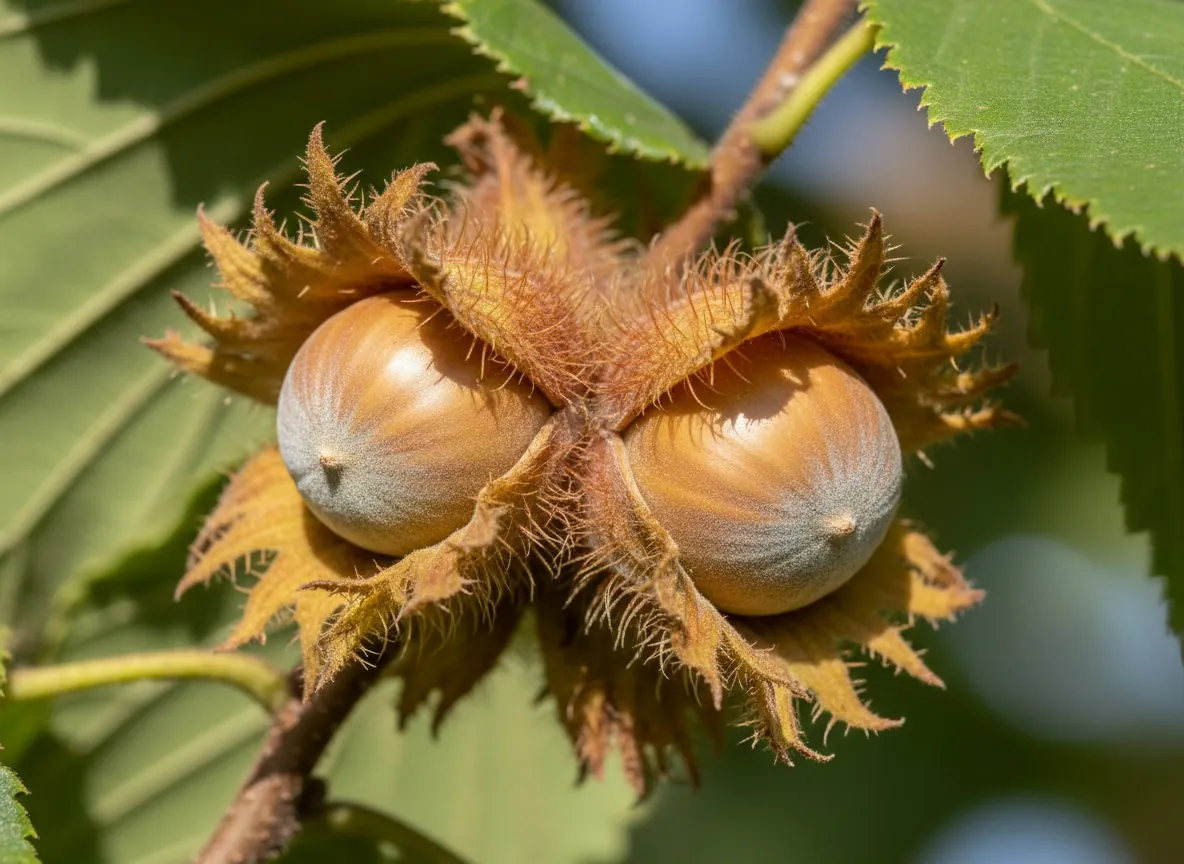
- The nuts are edible, but have a thick, hard shell and sit in a densely frayed husk — extracting them is laborious.
- It grows slowly, lives long (up to 150 years) and requires practically no formative pruning.
Botanical data
- Family
- Betulaceae (Betulaceae)
- Height
- 12–20 m
- Width
- 6–10 m
- Habit
- Conical
- Growth rate
- Slow
- Position
- Full sun, Partial shade
- Soil
- Loamy, Humus-rich, Sandy, Chalky
- pH reaction
- pH 6–8
- Moisture
- Dry, Moderate
- Bloom
- February–March
- Hardiness
- USDA 4a–8a
- Propagation
- From seed, From cuttings
Characteristics
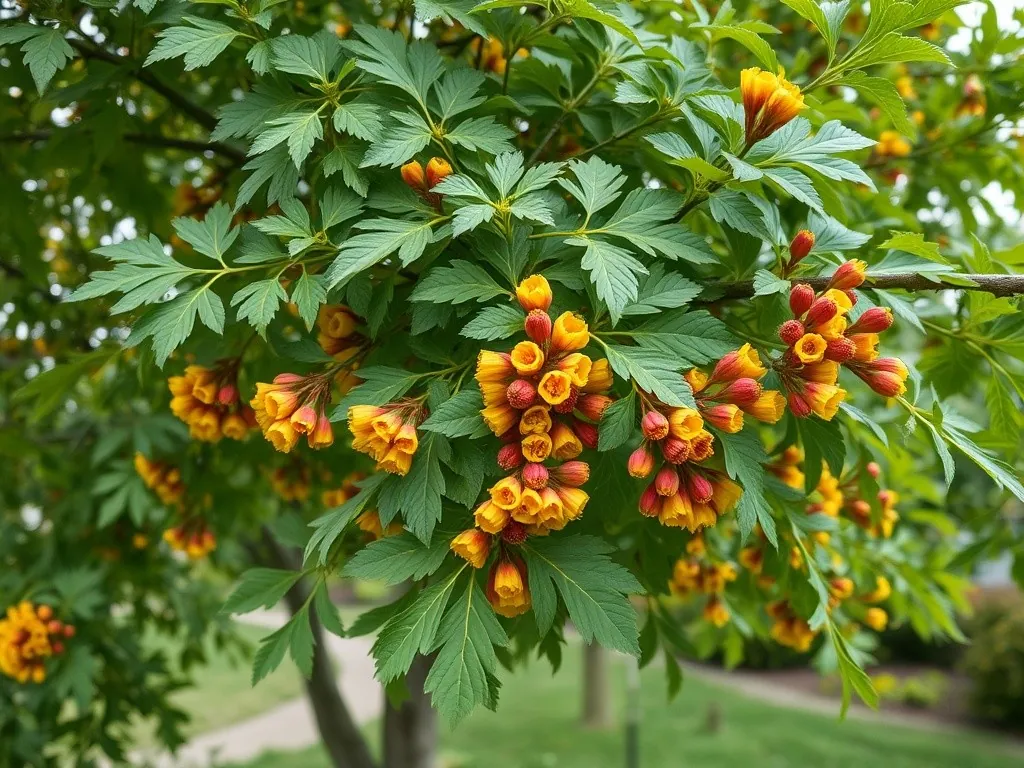
A tree with a straight, single trunk and an exceptionally regular crown, narrowly conical when young and broadly ovate with age. The bark is greyish-white, corky, deeply cracked into small, scaly plates — quite unlike the smooth bark of the shrubby common hazel and one of the easiest identifying features. The leaves are broadly ovate to roundish, with a heart-shaped base and a doubly serrated margin, turning yellow in autumn. The flowers are unisexual: the male ones in hanging, yellow catkins up to 10 cm long, the female ones inconspicuous, with red stigmas. The nuts are gathered in dense clusters of several to a dozen or so, wrapped in a strongly frayed, glandular husk; they are smaller than hazelnuts and have a markedly thicker shell.
Growing and care
Watering
Once established, the Turkish hazel is outstandingly resistant to drought, salinity and soil compaction — it is precisely these qualities that made it one of the most willingly planted avenue trees. Regular watering is needed only by young trees for the first 2–3 seasons after planting, before the taproot reaches deeper layers.
Fertilizing
A tree with very low nutrient requirements — mature specimens require no fertilising in practice. It is enough to keep the tree circle free of turf and to mulch it with organic matter.
Planting
It tolerates almost any well-drained soil, including compacted, dry and calcareous ones. A key point: the Turkish hazel develops a taproot — an exception in the genus Corylus — thanks to which it does not lift pavement surfaces, but which also means it takes badly to the transplanting of older specimens. Buy only root-balled or container-grown material and plant it in its final position straight away, with room to spare for a crown 6–10 m in diameter.
Pruning
It requires practically no pruning — the regular, conical crown forms by itself and that is its greatest advantage in urban greenery. Limit yourself to removing dead, diseased and crossing shoots, together with any rootstock suckers and lower branches conflicting with the road clearance.
Companion plants
Good companions
They shed pollen at the same, very early time, and the Turkish hazel can pollinate hazelnut cultivars; it also serves as a rootstock for standard, tree-form specimens of common hazel.
The deep taproot system of the Turkish hazel competes little in the upper soil layer, thanks to which shade-loving ground-cover perennials grow well beneath its crown.
It tolerates the dry shade under the tree's crown and covers the tree circle without competing for water at the same depth as the hazel's taproot.
Bad companions
A mature tree casts a dense, solid shade over an area 6–10 m in diameter — beneath it only shade-loving species succeed, while sun-loving plants become drawn and decline.
Turf competes effectively with a young tree for water and nitrogen in the upper soil layer, markedly slowing its growth over the first years — and the Turkish hazel grows slowly anyway.
The evidence level indicates whether the relationship is backed by research, observation, or gardening tradition.
Toxicity
| For whom | Level | Notes |
|---|---|---|
| Humans | None | The nuts are fully edible, with a flavour close to that of the hazelnut. Note: hazelnuts are among the most common food allergens and are subject to mandatory labelling in the EU — allergic individuals should avoid them. |
| Dogs | None | — |
| Cats | None | — |
History and origin
The species comes from the Balkans, Asia Minor and the Caucasus, and reached the gardens of Western Europe at the end of the 16th century by way of Vienna, where plants were brought from the territories of the Ottoman Empire. For centuries it remained a collector's curiosity of parks and arboreta. Its real career began only in the second half of the 20th century, when trees were sought that could survive in ever more difficult urban conditions — drought, winter salinity, compacted soil and limited root space. Today the Turkish hazel is one of the stalwart species in street greenery projects in Poland and Germany.
Uses
Above all an avenue and street tree — for planting streets, car parks, squares and pedestrian routes, where resistance to difficult conditions and a predictable, regular habit requiring no pruning are what count. In parks and large gardens a striking specimen tree with a distinct, conical silhouette. In fruit growing it is used as a rootstock for standard forms of hazelnut, and in forestry as an admixture. The nuts are edible, though difficult to process; the wood is valued in joinery.
Trivia
- Although the hazel is wind-pollinated and yields no nectar, its pollen can be one of the first foods for bees after winter — the catkins shed pollen as early as February.
- The Turkish hazel serves as a rootstock for standard forms of hazelnut: thanks to it, the shrubby common hazel can be grown as a small tree on a single trunk.
- The taproot is an exception in the genus Corylus — it is precisely thanks to it that the Turkish hazel does not lift pavement surfaces and copes so well with urban conditions.
Frequently asked questions
How does Turkish hazel differ from common hazel?
These are two different species of the same genus, and they differ above all in growth form. The common hazel (Corylus avellana) is a multi-stemmed shrub 3–6 m tall, suckering from the base, with smooth bark and a shallow, spreading root system. The Turkish hazel (C. colurna) grows as a single tree up to 15–20 m, has one straight trunk, a regularly conical crown, greyish-white, corky cracked bark and a taproot. They also differ in their nuts: in the Turkish hazel they are smaller, have a thicker shell and sit in a densely frayed husk. The Turkish hazel copes far better with drought, salinity and urban conditions.
Can the nuts of Turkish hazel be eaten?
Yes, they are edible and taste similar to ordinary hazelnuts. In practice, however, they are rarely gathered: they are smaller, have a markedly thicker and harder shell, and on top of that sit firmly in a fused, densely frayed husk from which they are hard to extract. The ratio of work to kernel obtained is simply unfavourable. If the aim is a nut harvest, it is far better to plant cultivated varieties of common hazel; the Turkish hazel is planted for its habit and resistance, not for its crop.
Why is Turkish hazel planted along streets so often?
Because it combines qualities rarely sought in a single tree. It withstands drought, salinity from winter de-icing, compacted and alkaline soil, and air pollution. Its taproot goes down deep instead of pushing about just beneath the surface, so it does not damage pavements and kerbs. The crown grows regularly and conically without intervention, which radically lowers maintenance costs — the tree needs no formative pruning. Added to this are its longevity (up to 150 years) and the absence of serious diseases. The downside is its slow rate of growth and its ultimately considerable size, which must be allowed for at the design stage.
Sources
- Plants of the World Online (POWO)Database (GBIF, POWO…)
- Missouri Botanical Garden — Corylus colurnaInstitution / botanical garden
My note
A private note for this plant — saved in your browser.