In short
- A barrel-shaped giant: up to 2 m in nature and over 100 years of life; it grows very slowly.
- Massive, hooked central spines — the most formidable armament among pot cacti.
- MYTH: it is not a desert water source — the flesh is alkaline and causes vomiting.
- Mature specimens lean towards the south-west, hence the name “compass cactus”.
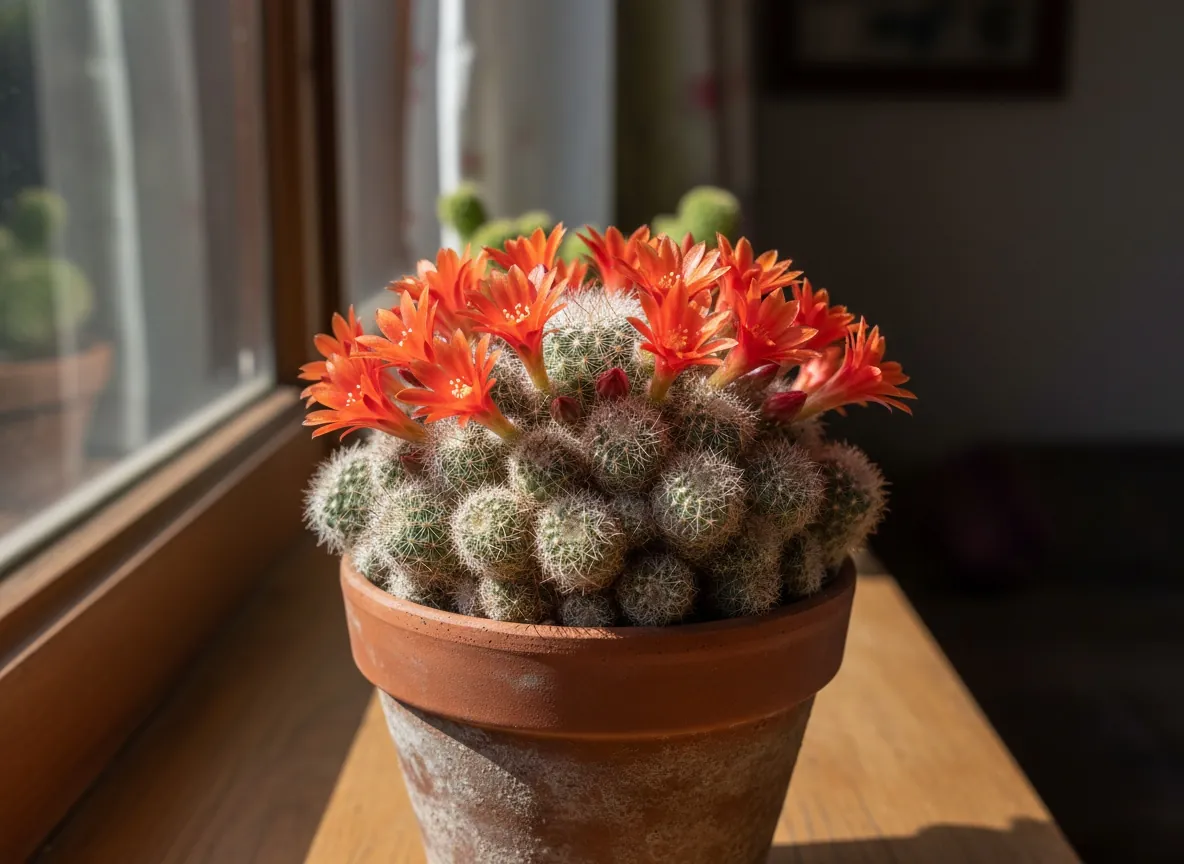
- A ring of orange flowers at the top, in high summer, after the monsoon rains.
- It requires a dry, cool (8–12°C) winter rest; it flowers only after more than a decade.
Botanical data
- Family
- Cactaceae (Cactaceae)
- Height
- 0.3–2 m
- Width
- 0.3–0.8 m
- Habit
- Rounded
- Growth rate
- Slow
- Position
- Full sun
- Soil
- Sandy
- pH reaction
- pH 6.5–8
- Moisture
- Dry
- Bloom
- July–September
- Hardiness
- —
- Propagation
- From seed
Characteristics
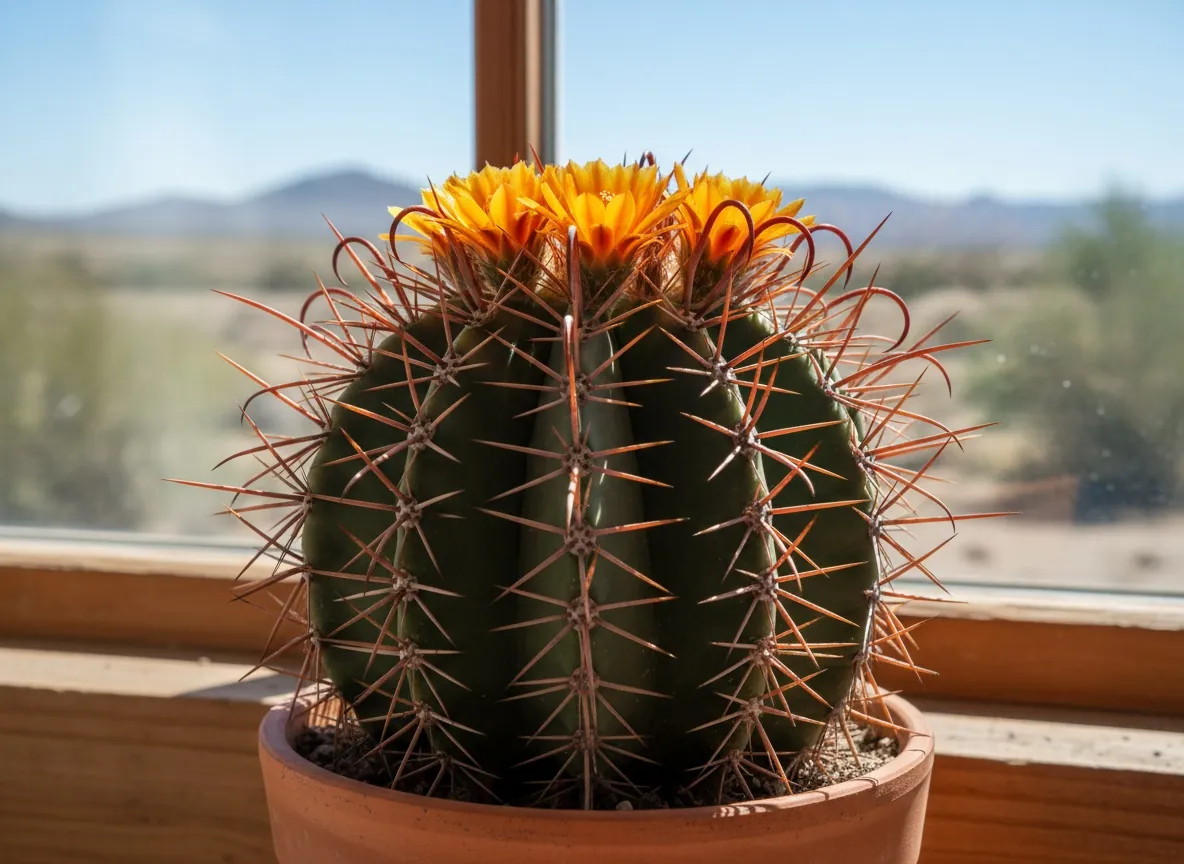
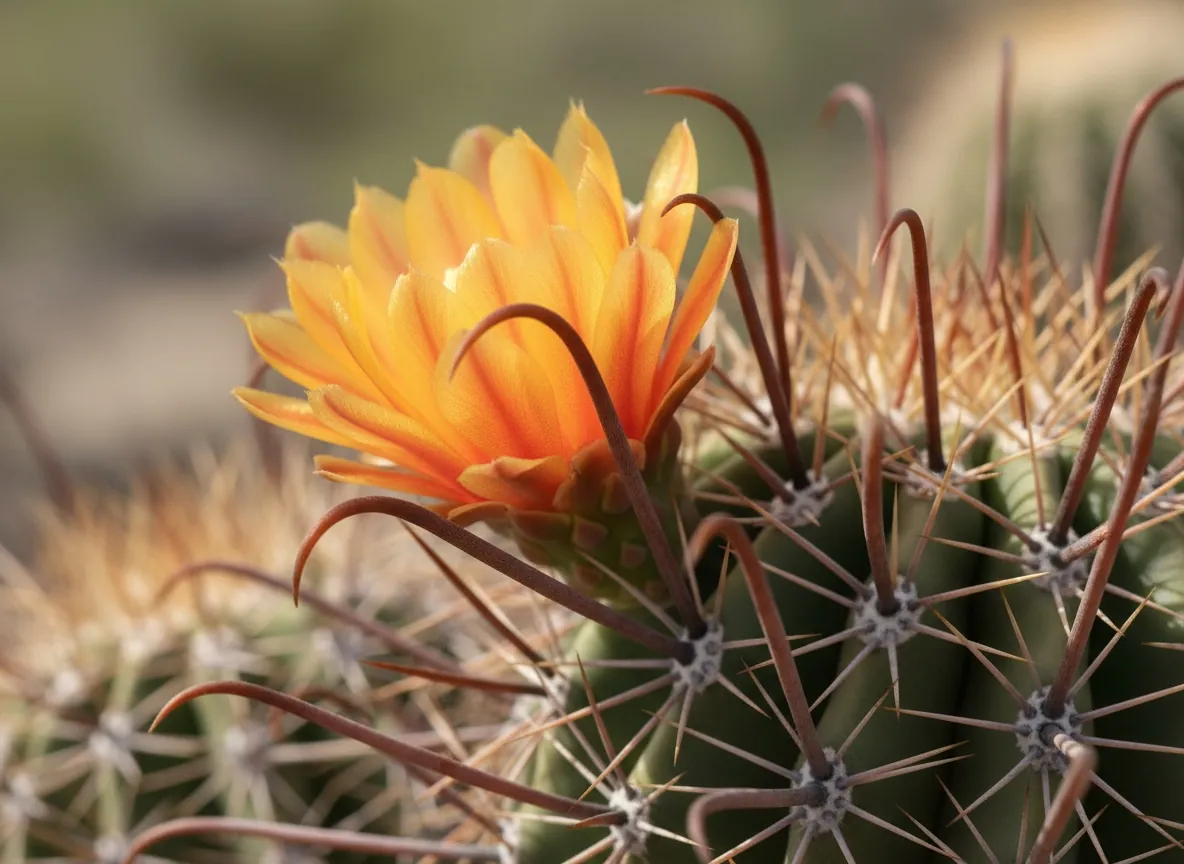
A cactus with a single, globular body which with age elongates into its characteristic barrel — in nature reaching 2 metres in height and half a metre in diameter, in a pot remaining considerably smaller for decades. The body is dark green, with 20-30 very pronounced, sharp ribs that work like an accordion: after a monsoon downpour the plant swells and the ribs move apart, and in drought it shrinks and the ribs draw together again. The areoles on the crests of the ribs bear a double armament: a ring of thin, whitish radial spines resembling bristles, and four massive central spines in colours from pinkish grey to brick red, 5-10 cm long, the largest of which is distinctly bent into a hook at the end — the feature from which the species takes its English name fishhook barrel. The genus name Ferocactus (from the Latin ferox — fierce, savage) describes exactly the same thing. In high summer, after the rainy season, the top is crowned by a ring of squat, fleshy flowers in shades of orange, yellow and brick red, after which bright yellow, barrel-shaped fruits set, persisting on the plant for many months, not infrequently until the next flowering.
Growing and care
Watering
From May to September water generously, but only once the root ball has dried out completely — the plant then imitates the monsoon rhythm of its habitat: a rare downpour, then a long drought. From November to March do NOT water at all and keep it at 8–12°C; a dry, cool winter rest is a condition for flowering and compact growth. Watering in winter in a warm place is the most common cause of root collar rot and of losing a plant that has been grown for over a decade.
Fertilizing
Very sparingly and only in the growing season. The species grows slowly by nature; forcing growth with nitrogen produces a soft, bloated body with thin, poorly coloured spines and encourages the skin to split.
Planting
A mineral cactus substrate with a large proportion of grit and pumice, of neutral to alkaline reaction. The pot deep and heavy — the ferocactus has a massive taproot and with age becomes genuinely heavy. Top-dress with gravel. Repot into dry substrate and do not water for 7-10 days, so that the damaged roots have time to heal over.
Pruning
One removes only the dried remains of flowers and fruits from the top — with long-armed tweezers, because there is no reaching between the hooked spines with your fingers.
Companion plants
Good companions
A barrel cactus with an identical cultivation regime — full sun, mineral alkaline substrate, a dry and cool winter rest; both form the same globular silhouette.
A cactus from the same North American deserts, with the same soil and water needs; both tolerate being put out on the terrace for the summer.
A succulent with an identical habitat and identical care, with a contrasting rosette silhouette — a classic combination in desert compositions.
Bad companions
The fern requires constantly moist substrate and humid air — in such conditions the root collar of the ferocactus rots.
The hooked spines catch in skin and clothing at the lightest brush and tear the wound open when you try to pull them out — the plant is placed away from thoroughfares, not beside them.
The evidence level indicates whether the relationship is backed by research, observation, or gardening tradition.
Toxicity
| For whom | Level | Notes |
|---|---|---|
| Humans | None | The plant is not toxic, and its ripe fruits are edible. Beware of two things: the hooked spines inflict serious wounds that are hard to dress (they catch and tear the skin when pulled out), and the juicy flesh — contrary to the widespread legend of the “cactus with drinking water” — is strongly alkaline and, drunk in any quantity, causes nausea, vomiting and diarrhoea. |
| Dogs | None | Non-toxic, but the hooked spines are a real mechanical hazard — stuck into the muzzle or a paw, they usually require removal by a vet. |
| Cats | None | — |
History and origin
The species was described in the middle of the 19th century and named after Friedrich Adolph Wislizenus, a German physician and naturalist who documented the flora of the American south-west during expeditions in the 1840s. For the indigenous inhabitants of the Sonoran Desert — the Tohono O'odham and the Seri — the ferocactus was a useful plant: its sour fruits were gathered, and the hooked spines were used as fish hooks, which is incidentally the simplest explanation of both of its names. The settlers discovered this plant in a different way: from its flesh they made so-called cactus candy — candied cubes sold as a souvenir from Arizona. Demand proved great enough that, together with the later digging up of mature specimens for ornamental gardens, it severely thinned the natural populations. Today the ferocactus, like all native cacti of Arizona, is legally protected there and may neither be destroyed nor dug up without a permit.
Uses
A striking, statuesque collector's plant for the brightest, fully sunlit position — one of those cacti that with age become a genuine specimen rather than just a pot on the windowsill. In summer it is readily put out on a terrace in full sun, after gradual hardening off. Because of its hooked spines, however, it requires a well-considered place: away from walkways, doors, low shelves and the reach of children and animals. In warm countries (Arizona, California, the Mediterranean region) it is planted in the ground as an element of xerophytic gardens.
Trivia
- The legend of the barrel cactus as a desert source of drinking water, known from westerns and survival guides, is false and potentially dangerous. Inside the plant there is no free water, only a mucilaginous, strongly alkaline flesh; the juice squeezed from it, drunk in any quantity, causes nausea, vomiting and diarrhoea — exactly what dehydrates a dehydrated person still further. On top of that, breaking open a woody cactus bristling with hooks costs more effort and sweat than the possible gain is worth.
- Mature specimens lean distinctly towards the south-west, because the more strongly sunlit side grows more slowly than the shaded one — hence the common name “compass cactus” and the old custom of orienting oneself by it in the field. For the plant itself this is not beneficial, however: very old, strongly leaning specimens can simply topple over.
- The hooked spines are not an ornament but a precise tool — the indigenous inhabitants of the Sonoran Desert used them as ready-made fish hooks. The same construction makes them exceptionally unpleasant on contact: the spine hooks into the skin and, when jerked, tears the wound open instead of coming out of it.
Frequently asked questions
Can you drink water from a ferocactus in the desert?
No — this is one of the most persistent and most harmful legends about cacti. Inside the plant there is no reservoir of water, only a mucilaginous, fibrous and, on top of that, strongly alkaline flesh. The juice squeezed from it and drunk in any quantity causes nausea, vomiting and diarrhoea, that is it dehydrates a person even more than they already were — in an emergency it therefore does the exact opposite of what is expected of it. On top of that, breaking open the woody body of the plant, bristling with hooks, costs considerable effort and sweat. In Arizona the ferocactus is additionally protected by law, so destroying it is simply illegal. What is edible are the ripe, yellow fruits — sour, with a lemony aftertaste — and it was they, not the flesh, that were the real desert food.
My ferocactus is growing crooked and leaning to one side — is something wrong?
Most likely not; this is natural behaviour for the species and the reason it is called the compass cactus. The more strongly sunlit side grows more slowly than the shaded one, so over time the plant bends towards the sun — in its native hemisphere towards the south-west, here towards the window. If an even habit matters to you, turn the pot a quarter turn every few weeks. Do not straighten the plant by force and do not tie it to a support. Something entirely different, however, is a sudden lean with a soft, dark patch at the base — that is already a symptom of root collar rot, usually after winter watering.
How do you repot a ferocactus safely?
Gardening gloves are not enough — the hooked spines pierce them and catch in the material. A proven method is a thick belt of newspaper rolled up several times, a piece of carpet or polystyrene, with which you wrap the plant around the middle like a band and lift it by that belt. Repot in spring, in dry substrate (do not water for a week before the operation or for 7-10 days after it — the damaged roots must heal over before they get water). If a spine does stick in, pull it out with tweezers along the axis it entered, calmly; a jerk makes the hook tear the wound open instead of coming out of it. For reaching between the spines, for example for dried fruits, tweezers with long arms are useful.
Sources
- Plants of the World Online (POWO)Database (GBIF, POWO…)
- Arizona-Sonora Desert Museum — Ferocactus wislizeniInstitution / botanical garden
My note
A private note for this plant — saved in your browser.