In short
- Absolutely requires acidic soil (pH 4.0–5.0) — on neutral or alkaline soil it yellows and dies; this is a condition that admits no exceptions.
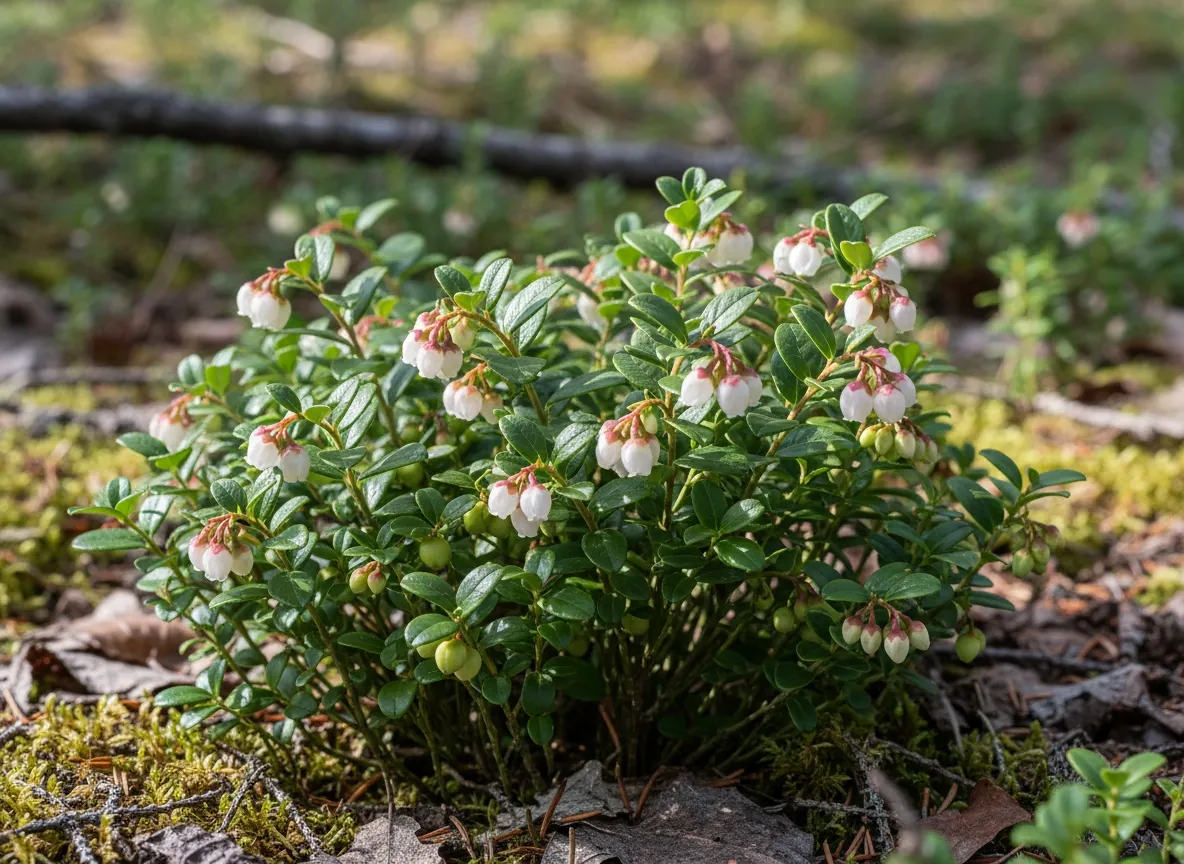
- An evergreen dwarf shrub 10–30 cm tall, spreading by underground runners into a dense carpet.
- Extremely frost-hardy — a boreal species, in Poland a natural component of the ground layer of pine forests.
- Water with rainwater: hard tap water gradually raises the pH of the substrate and causes chlorosis.
- In cultivation the cultivars often flower twice a season and give two harvests — one in August and one in September–October.
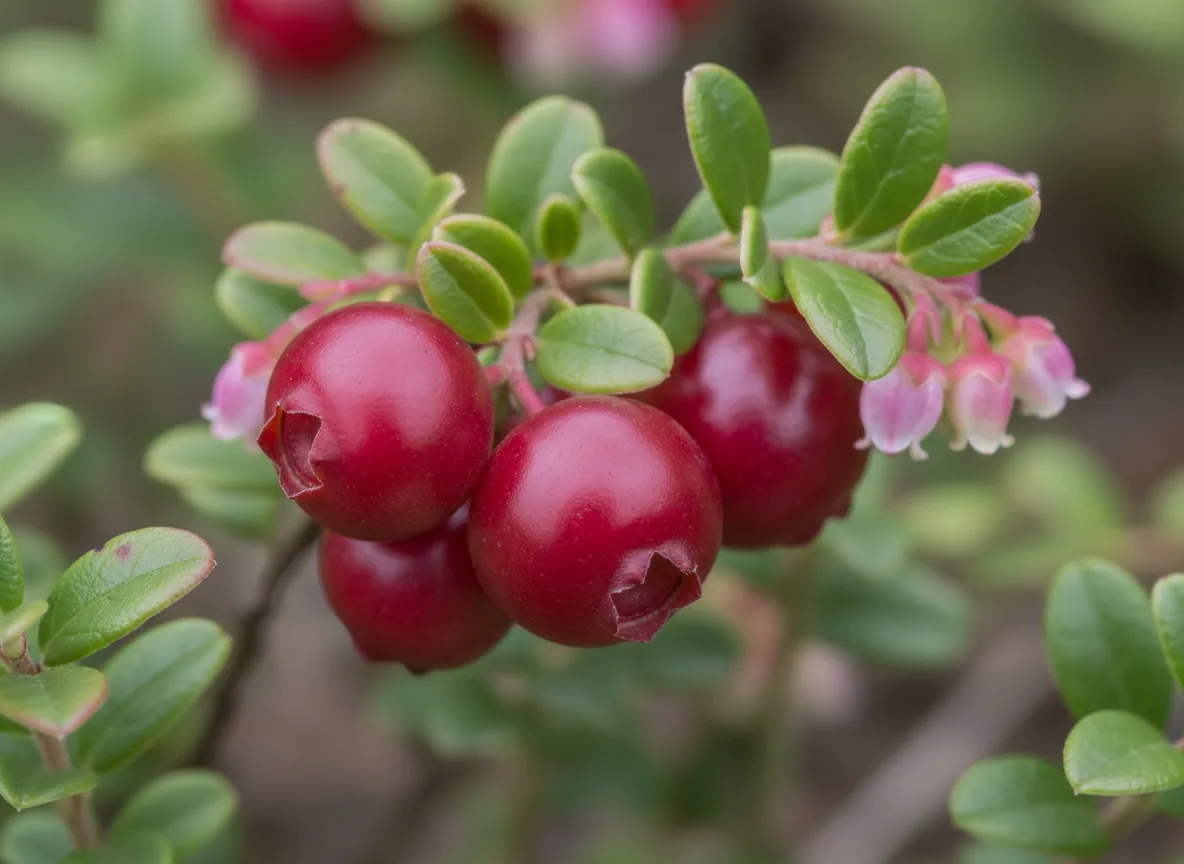
- The fruits are sour and slightly bitter, classically made into lingonberry sauce for meats.
Botanical data
- Family
- Ericaceae (Ericaceae)
- Height
- 0.1–0.3 m
- Width
- 0.2–0.4 m
- Habit
- Creeping
- Growth rate
- Slow
- Position
- Full sun, Partial shade
- Soil
- Peaty, Sandy, Humus-rich
- pH reaction
- pH 4–5
- Moisture
- Moderate, Moist
- Bloom
- May–June
- Hardiness
- USDA 3a–8a
- Propagation
- By runners, From cuttings, By division
Characteristics
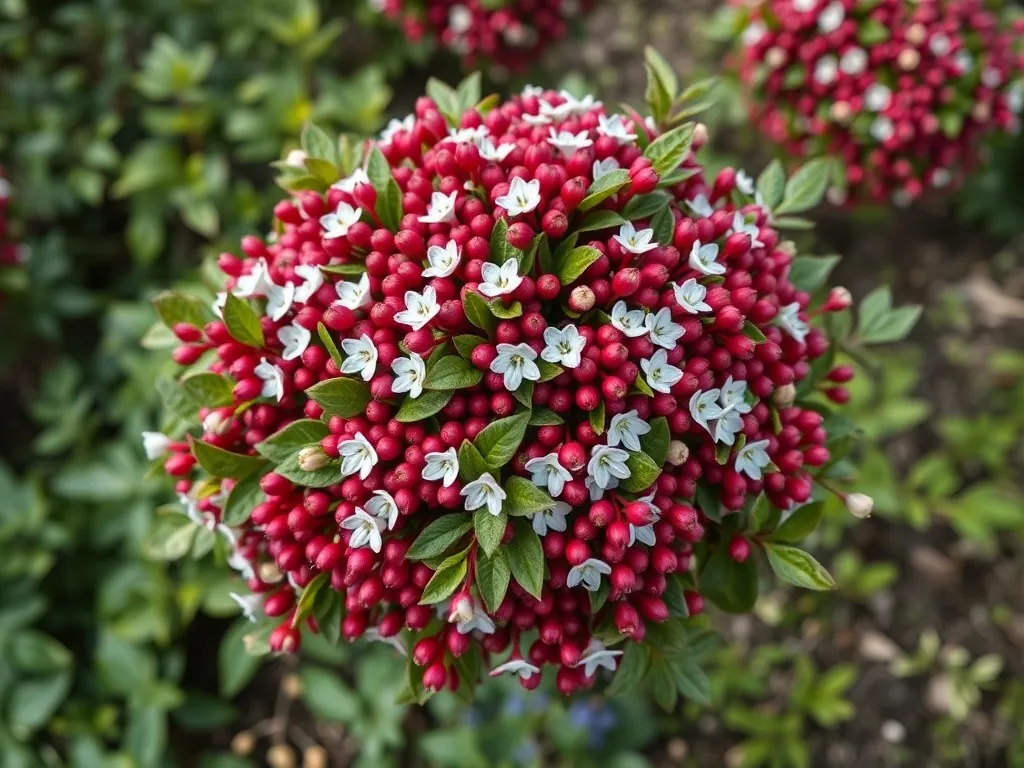
A low dwarf shrub with woody, creeping underground shoots (runners), from which short, upright branches grow. The leaves are small (1–3 cm), leathery, evergreen, obovate, with a slightly rolled-under margin — dark green and glossy above, paler beneath and covered with small, dark glands, which is the most reliable identifying feature of the species. The flowers are bell-shaped, white to pale pink, gathered several together in short racemes at the shoot tips. The fruits are spherical berries, at first whitish-green, when fully ripe intensely red and glossy, with sour flesh and a perceptible bitterness.
Growing and care
Watering
Water exclusively with rainwater or softened water. Hard tap water contains calcium, which gradually raises the reaction of the substrate — after a few seasons the lingonberry begins to yellow (chlorosis), despite correct care in every other respect. The shallow root system dries out quickly, so frequent and moderate watering is better than infrequent and heavy.
Fertilizing
The lingonberry grows naturally on extremely poor soils and is very sensitive to over-fertilising — it is easier to salt it than to starve it. Absolutely do not use lime, calcium fertilisers or ash; even a single liming of the bed can destroy the planting.
Planting
This is the most important stage of the cultivation and it cannot be skipped: the substrate must have an acidic reaction, pH 4.0–5.0. On typical garden soil the earth is replaced throughout the whole bed to a depth of about 30 cm, mixing acidic sphagnum peat with pine bark and sand. On neutral or alkaline soils it is often more sensible to grow it in a raised bed, box or container with controlled substrate — without this the lingonberry will sooner or later develop chlorosis. Mulch with pine bark.
Pruning
The plant does not require regular pruning. When the carpet thickens over the years and fruits less well, it is cut back for rejuvenation to a height of about 5 cm — this stimulates the development of new runners and fruiting shoots. On an ongoing basis it is enough to remove frost-damaged and injured shoots.
Companion plants
Good companions
The same genus Vaccinium and identical requirements — an acidic, humus-rich, well-drained substrate with a pH of 4–5. A natural choice for a shared acid-loving bed; the lingonberry works well as a low cover at the foot of taller shrubs.
An ericaceous plant with the same soil requirements; the lingonberry forms an evergreen cover under rhododendrons that shades their shallow roots and limits evaporation.
Another ericaceous plant sharing the requirement for acidic substrate and a sheltered position — they are easy to grow in one bed and care for in the same way.
Bad companions
They are mutually exclusive as regards soil: lavender needs neutral or alkaline soil and calcium, while at such a reaction the lingonberry cannot take up iron, yellows and dies. It is impossible to satisfy both plants with one substrate.
The lingonberry has shallow, delicate roots devoid of root hairs — it takes up nutrients solely thanks to ericoid mycorrhiza — and loses the competition for water and nutrients with turf or expansive perennials.
The evidence level indicates whether the relationship is backed by research, observation, or gardening tradition.
Toxicity
| For whom | Level | Notes |
|---|---|---|
| Humans | None | The fruits are fully edible — sour and slightly bitter, valued for their high content of phenolic compounds. |
| Dogs | None | — |
| Cats | None | — |
History and origin
The lingonberry has been gathered from the wild for centuries in Scandinavia, Russia and Central and Eastern Europe — in Poland it is known by the folk name gogodze. Thanks to their natural content of benzoic acid, its fruits kept through the winter without cooking or sugar, which made them one of the few sources of vitamin C available in winter in the cooking of northern peoples. Field and garden cultivation developed only in the second half of the 20th century, mainly in Germany, Sweden and Finland, where twice-fruiting cultivars were selected.
Uses
For beds of acid-loving plants, as a low, evergreen cover under rhododendrons, azaleas and highbush blueberry, for edgings, woodland and naturalistic gardens, and for banks. It does well in balcony boxes and containers with acidic substrate, where the reaction is easier to control than in the open ground. The fruits are made into sauces for game and meats, jams, preserves and dried fruit.
Trivia
- Lingonberry fruits contain natural benzoic acid acting as a preservative — in Scandinavia preserves are made from them without cooking, using only water and sugar.
- The lingonberry is easily confused with the bearberry growing in similar habitats: the lingonberry has small, dark glands on the underside of the leaf, the bearberry lacks them.
- The species name vitis-idaea means “vine of Mount Ida” — it refers to the mountain known from Greek mythology, although the plant has nothing in common with the grapevine.
Frequently asked questions
Why are the lingonberry's leaves yellowing?
It is almost certainly chlorosis — a symptom of iron deficiency, which the plant cannot take up when the reaction of the substrate is too high. The leaf blade yellows while the veins stay green. The cause is usually neutral or alkaline soil, watering with hard tap water, the proximity of concrete and lime mortar, or liming of a nearby lawn. Iron chelate helps in the short term, but that only masks the symptom — the lasting solution is acidifying the substrate (acidic peat, garden sulphur, fertilisers for acid-loving plants) and watering exclusively with rainwater.
How do you prepare the substrate for lingonberry?
The aim is a pH of 4.0–5.0. In the open ground the soil is replaced throughout the whole bed to a depth of about 30 cm, mixing acidic sphagnum peat with pine bark and sand — replacing just the planting hole is not enough, because the surrounding soil will quickly neutralise the substrate. On alkaline soils it is more sensible to grow it in a raised bed, a box or a container. The surface is mulched with pine bark, which additionally acidifies the substrate and retains moisture. Liming and the use of ash are absolutely forbidden.
How does lingonberry differ from bilberry and highbush blueberry?
These are three different species of the same genus Vaccinium, united by their requirement for acidic soil. The lingonberry is an evergreen dwarf shrub (10–30 cm) with leathery leaves and red, sour fruits ripening from August to October. The bilberry, that is the European blueberry (V. myrtillus), is a deciduous dwarf shrub 20–50 cm tall, with blue-black fruits that stain the mouth and juice, ripening in July. The American blueberry, that is the highbush blueberry (V. corymbosum), is a shrub up to 2 m tall with large, sweet, light blue fruits — and it is the species grown commercially.
Sources
- Plants of the World Online (POWO)Database (GBIF, POWO…)
- RHS — Vaccinium vitis-idaeaInstitution / botanical garden
My note
A private note for this plant — saved in your browser.