In short
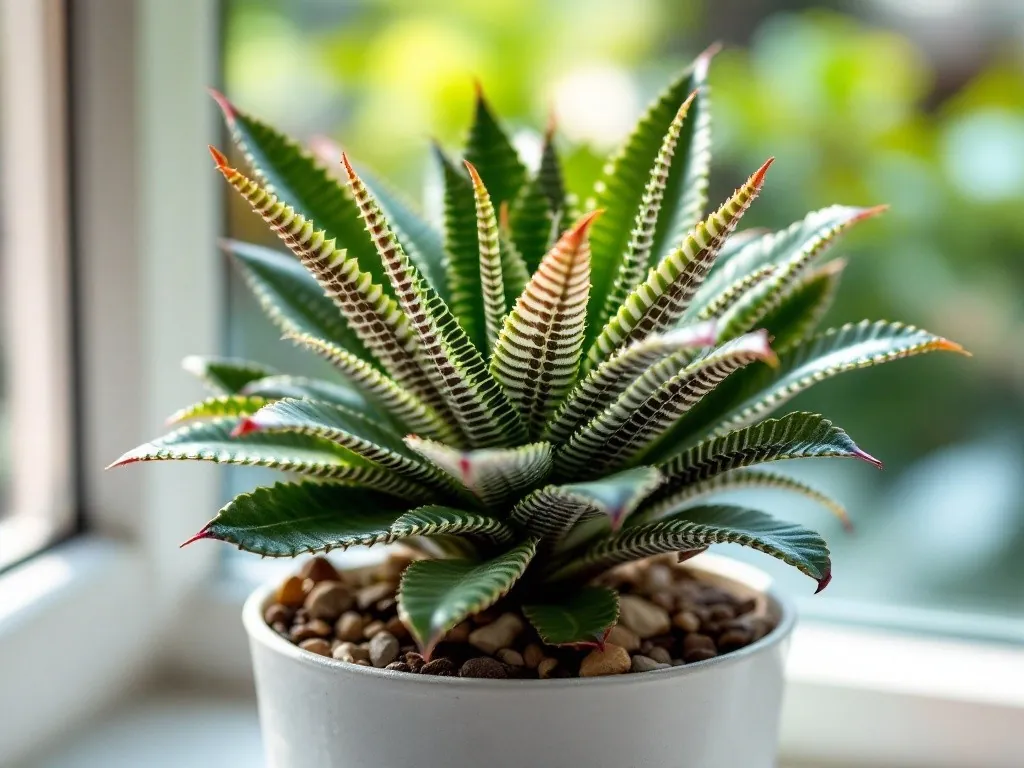
- Small rosette (5-10 cm) with dark green leaves in white cross-bands resembling a zebra's stripes.
- Unlike most succulents, it tolerates partial shade better than harsh, full sun.
- Very drought-tolerant and forgiving of occasional neglect — a good plant for beginners.
- Grows slowly, over time producing numerous offsets (pups) that form a dense colony.
- Not frost-hardy — grown solely as a houseplant/potted plant outside its native range.
Botanical data
- Family
- Asphodelaceae (Asphodelaceae)
- Height
- 0.05–0.1 m
- Width
- 0.1–0.15 m
- Habit
- Clump-forming
- Growth rate
- Slow
- Position
- Partial shade, Shade
- Soil
- Sandy
- pH reaction
- pH 6–7.5
- Moisture
- Dry
- Bloom
- May–July
- Hardiness
- USDA 10a–11b
- Propagation
- By division, From cuttings
Characteristics
A stemless succulent forming a small rosette of fleshy leaves, triangular in cross-section and arranged in spiral rows. The outer surface of the leaves is covered with raised, cross-banded white tubercles that create the characteristic striped pattern. Mature plants produce a tall, panicle-like flower stalk with small, whitish flowers.
Growing and care
Watering
Water only once the substrate has dried out completely. The very fine root system rots easily with excess water, especially in winter.
Fertilizing
Very undemanding — the plant grows slowly and doesn't need intensive feeding.
Planting
Well-draining mineral cactus and succulent substrate with added sand or perlite; a small, shallow pot with a drainage hole.
Pruning
Remove only drying, lower leaves and separate well-developed offsets (pups) into their own pots.
Companion plants
Good companions
Similar, moderate light requirements and identical well-draining substrate — they pair well together in arrangements on not-too-sunny windowsills.
Bad companions
In full, intense summer sun haworthia gets sunburned leaves, while sun-loving plants in the same partial-shade spot don't get enough light — growing them together in one bowl leads to a compromise unfavorable to one side.
The evidence level indicates whether the relationship is backed by research, observation, or gardening tradition.
Diseases and pests
Insects covered in a white, cottony, waxy coating, gathering in leaf axils, at the base of shoots and on the underside of leaf blades. They look like tufts of cotton wool. They suck sap, weaken the plant and excrete sticky honeydew, on which black sooty mould develops. A common pest of houseplants and succulents.
Spider mitesTiny (0.3–0.5 mm) arachnids, hard to spot with the naked eye, feeding on the underside of leaves. Symptoms: fine, pale speckling (feeding punctures); over time the leaves turn grey, yellow and dry out. Under heavy infestation a fine webbing becomes visible. Warm, dry air favours their development — a common problem for houseplants in winter near radiators.
Toxicity
| For whom | Level | Notes |
|---|---|---|
| Humans | None | — |
| Dogs | None | — |
| Cats | None | — |
History and origin
The genus Haworthia (and the later split-off genus Haworthiopsis) was named after the English botanist Adrian Hardy Haworth, a 19th-century succulent specialist. Zebra haworthia has long been one of the most popular and readily available haworthias in indoor cultivation, thanks to its striking, regular leaf pattern and modest requirements.
Uses
For bright rooms that don't necessarily get full sun — it does well on east- and west-facing windowsills, in bathrooms with a window, and in mineral potted arrangements with other small succulents.
Trivia
- The characteristic white cross-bands are hard, raised growths (tubercles) on the leaf surface rather than pigmentation — they can be felt as a slightly rough texture under the fingers.
- Zebra haworthia is sometimes confused with the similar-looking Haworthiopsis attenuata, in which the tubercle bands cover the leaf evenly on both sides rather than only on the outer surface as in H. fasciata.
Frequently asked questions
Where does zebra haworthia get its name and characteristic pattern?
The white cross-bands on the leaves are hard, raised tubercles arranged in regular rows that resemble a zebra's markings — hence the common name "zebra haworthia".
Can zebra haworthia be kept in full sun?
This isn't recommended — unlike many other succulents, haworthia comes from naturally shaded habitats and easily gets sunburned leaves in intense, direct summer sun. It does better on a bright windowsill without direct, scorching midday sun.
How often should zebra haworthia be watered?
Very rarely — only once the substrate has dried out completely, usually about once every 10-14 days in summer and once a month in winter. Overwatering is far more harmful to this plant than underwatering.
Sources
- Plants of the World Online (POWO)Database (GBIF, POWO…)
- RHS — Haworthiopsis fasciataInstitution / botanical garden
My note
A private note for this plant — saved in your browser.