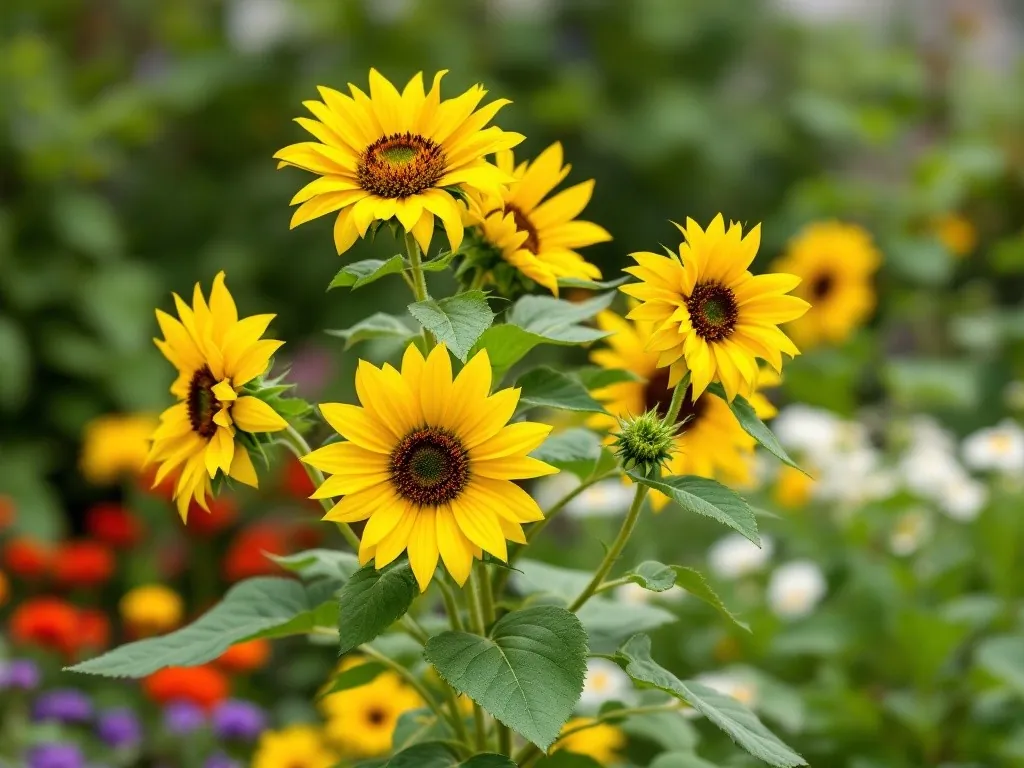
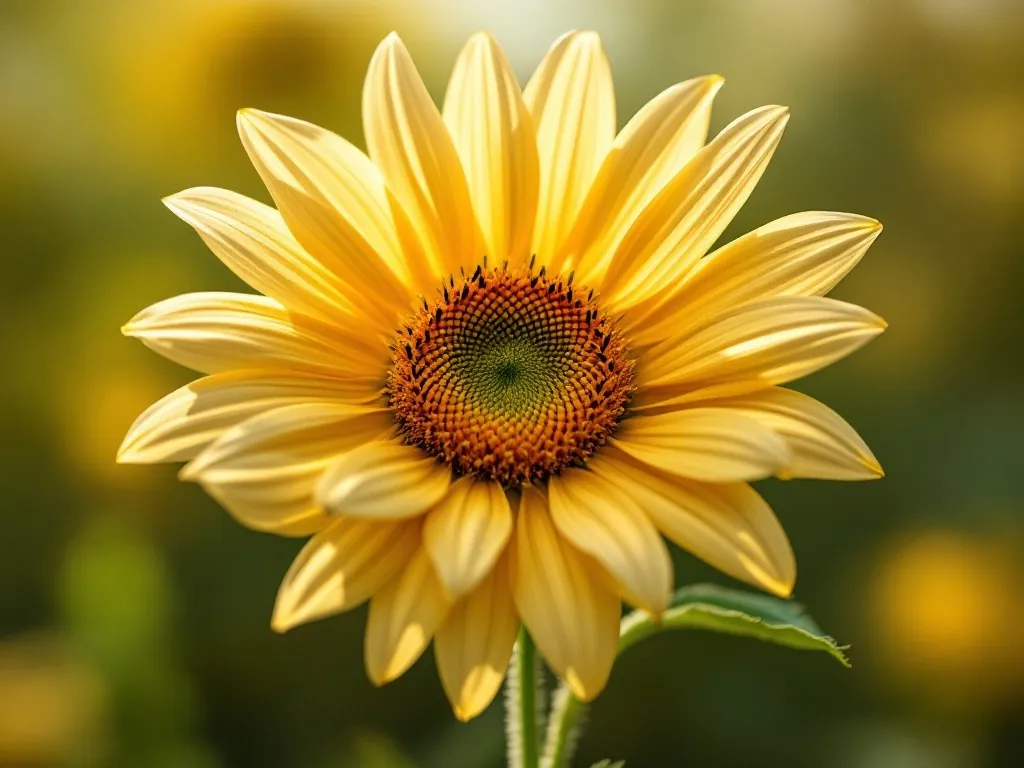
In short
- Grows very fast — from seed to flower in a single season.
- Requires full sun and regular watering.
- Young flower heads show heliotropism — they track the sun.
- Strongly attractive to bees, and the seeds are valuable bird food.
- Tall varieties need staking.
Botanical data
- Family
- Asteraceae (Asteraceae)
- Height
- 0.5–3.5 m
- Width
- 0.3–0.6 m
- Habit
- Upright
- Growth rate
- Fast
- Position
- Full sun
- Soil
- Humus-rich, Loamy, Sandy
- pH reaction
- pH 6–7.5
- Moisture
- Moderate
- Bloom
- July–September
- Hardiness
- USDA 3a–10b
- Propagation
- From seed
Characteristics
A plant with a thick, hairy stem and large, heart-shaped leaves. The flower head is a showy composite made up of ray florets (the "petals") and numerous small disc florets in the center, from which the seeds develop.
Growing and care
Watering
Needs regular watering during the rapid growth phase and while forming its flower head, especially tall varieties.
Fertilizing
Too much nitrogen produces lush foliage at the expense of flowers; potassium supports strong stems.
Planting
Fertile, free-draining soil in full sun; tall varieties should be secured with a stake.
Pruning
Remove spent flower heads if the seeds aren't being left for birds.
Companion plants
Good companions
The sunflower can act as a trap crop drawing off some pests, and its tall stems give light shade to heat-sensitive vegetables.
The sunflower's tall stems can serve as a natural support for climbing cucumbers.
Bad companions
The sunflower releases allelopathic substances that can inhibit the growth of potatoes planted in close proximity.
The evidence level indicates whether the relationship is backed by research, observation, or gardening tradition.
Diseases and pests
Toxicity
| For whom | Level | Notes |
|---|---|---|
| Humans | None | — |
| Dogs | None | — |
| Cats | None | — |
History and origin
The sunflower was domesticated by Indigenous peoples of North America thousands of years ago as a food and oil crop. Brought to Europe in the 16th century, it is now one of the world's most important oilseed crops.
Uses
For ornamental gardens, as a cut flower, as a screening plant, and for plantings that attract pollinators and birds. Short varieties suit large containers.
Trivia
- Young sunflower heads show heliotropism, turning to track the sun, but mature heads usually settle facing east.
- The arrangement of seeds in the flower head follows the mathematical Fibonacci sequence.
Frequently asked questions
Why does my sunflower fall over?
Tall varieties with a heavy flower head snap easily in the wind. It's worth giving them sturdy staking from the start and planting them in a spot sheltered from strong wind.
Does the sunflower really turn to follow the sun?
Yes, but this mainly applies to young, still-developing plants (heliotropism). Mature flower heads usually settle facing east.
When should sunflower seeds be harvested?
When the back of the flower head turns yellow and the seeds are plump and firm — usually in September or October. You can also leave the head in place as a bird feeder.
Sources
- Plants of the World Online (POWO)Database (GBIF, POWO…)
- RHS — Helianthus annuusInstitution / botanical garden
My note
A private note for this plant — saved in your browser.