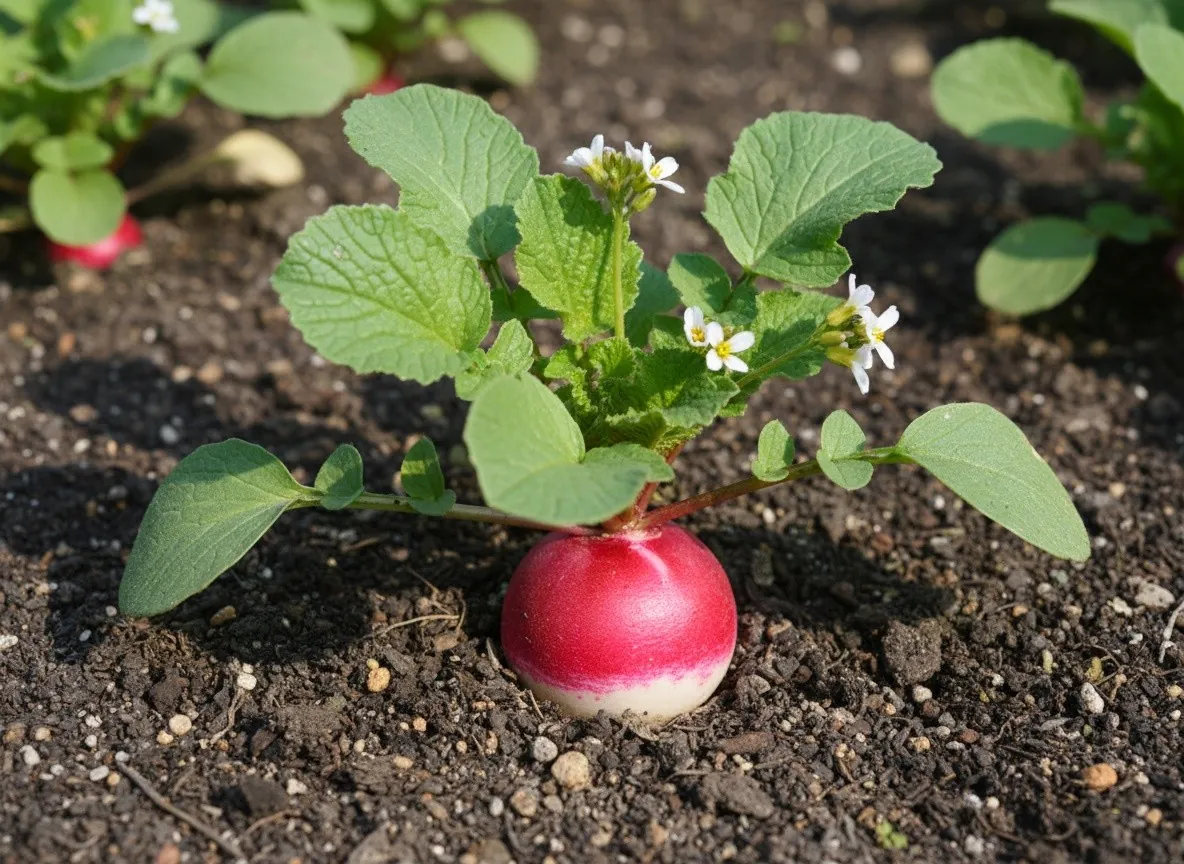
In short
- The fastest vegetable — ready to harvest just 3-4 weeks after sowing.
- Needs steady moisture — drought makes the roots woody and pungent.
- Sow successively every 2 weeks for a continuous harvest.
- Ideal for children and beginners thanks to the quick results.
- Do not leave in the ground too long — mature roots crack and turn woody.
Botanical data
- Family
- Brassicaceae (Brassicaceae)
- Height
- 0.1–0.25 m
- Width
- 0.05–0.1 m
- Habit
- Clump-forming
- Growth rate
- Fast
- Position
- Full sun, Partial shade
- Soil
- Humus-rich, Sandy
- pH reaction
- pH 6–7
- Moisture
- Moderate
- Bloom
- June–July
- Hardiness
- USDA 3a–10b
- Propagation
- From seed
Characteristics
A low-growing plant with a rosette of rough leaves and a swollen, round or elongated storage root with red, white or bicoloured skin and firm, crisp, sharp-tasting white flesh.
Growing and care
Watering
Needs even moisture — a lack of water makes the roots woody, cracked and sharply pungent.
Fertilizing
On fertile soil no feeding is needed; excess nitrogen produces lush foliage at the expense of the roots.
Planting
Fertile, free-draining, loosened soil; sow successively for a continuous harvest.
Pruning
Harvest as you go, once the roots reach the right size — left in the ground too long they turn woody and crack.
Companion plants
Good companions
The fast radish marks out the rows and loosens the soil, and is harvested before the slow carrot needs the space.
Both are fast-growing, low plants with similar requirements — good for intercropping and successive sowing.
Bad companions
Cucurbits can compete with radishes and encourage shared pests when planted close together.
The evidence level indicates whether the relationship is backed by research, observation, or gardening tradition.
Diseases and pests
Toxicity
| For whom | Level | Notes |
|---|---|---|
| Humans | None | — |
| Dogs | None | — |
| Cats | None | — |
History and origin
Radishes have been cultivated in Asia and the Mediterranean basin for thousands of years. The small, fast radish is a relatively recent European form selected for quick cultivation and eating raw.
Uses
For the vegetable garden, balcony boxes and pots. The roots are eaten raw; excellent for learning gardening and for intercropping.
Trivia
- The radish's pungent flavour comes from sulphur compounds (isothiocyanates) — the same ones that give mustard and horseradish their bite.
- Radishes are sometimes sown as a marker plant to indicate the rows of slow-germinating vegetables.
Frequently asked questions
Why is my radish pungent and woody?
The main causes are lack of water and leaving the roots in the ground too long after they mature. Even watering and harvesting at the right moment give mild, crisp roots.
Why does my radish produce only leaves and no swollen root?
The most common causes are sowing too densely, excess nitrogen and too little light. Thin the radishes out, avoid nitrogen fertilising and plant them in a sunny spot.
How fast does a radish grow?
Very fast — from sowing to harvest usually takes only 3-4 weeks, which makes it the fastest vegetable in the garden and ideal for the impatient and for children.
Sources
- Plants of the World Online (POWO)Database (GBIF, POWO…)
- RHS — RadishInstitution / botanical garden
My note
A private note for this plant — saved in your browser.