In short
- Plant in autumn; blooms in early spring (March–April).
- All parts are toxic – this deters rodents and deer.
- Leave the foliage until it yellows – it feeds the bulb.
- Naturalizes readily – forms larger clumps year after year.
- Tulips, which aren't toxic to rodents, benefit from being planted near daffodils.
Botanical data
- Family
- Amaryllidaceae (Amaryllidaceae)
- Height
- 0.2–0.5 m
- Width
- 0.1–0.15 m
- Habit
- Upright
- Growth rate
- Fast
- Position
- Full sun, Partial shade
- Soil
- Humus-rich, Loamy
- pH reaction
- pH 6–7
- Moisture
- Moderate
- Bloom
- March–April
- Hardiness
- USDA 3a–9a
- Propagation
- From bulbs / tubers
Characteristics
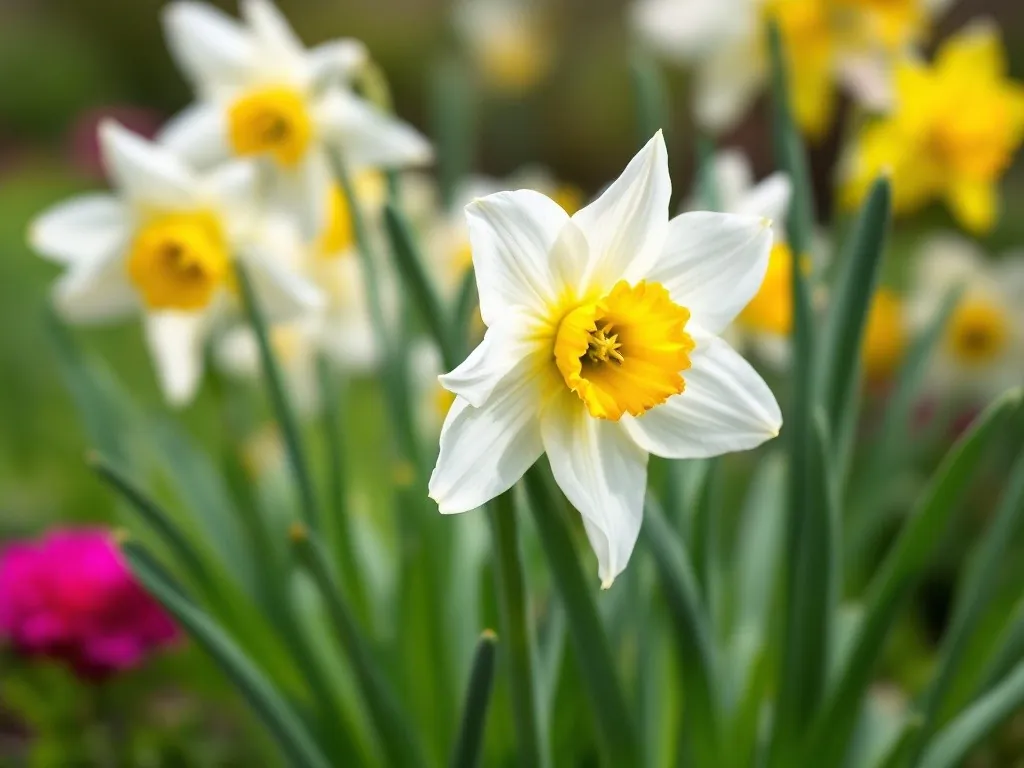
A bulbous plant with narrow, strap-shaped leaves and flowers made up of six tepals plus a central trumpet- or cup-shaped corona, usually in shades of yellow and white.
Growing and care
Watering
Needs moisture during growth and flowering (spring); in summer, after the foliage dies back, the bulbs rest dormant in dry soil.
0Fertilizing
Supports flowering and bulb regeneration for the next season.
Planting
Well-drained soil; plant at a depth of about 2-3 times the bulb's height.
Pruning
Remove spent flowers, but leave the foliage until it yellows naturally – it feeds the bulb.
Companion plants
Good companions
Similar planting and flowering time; the toxicity of daffodil bulbs also deters rodents that might otherwise dig up tulip bulbs.
They hide the yellowing daffodil foliage after flowering.
Bad companions
Freshly cut daffodils release a sap that's toxic to other flowers in the bouquet – they should be soaked separately first.
The evidence level indicates whether the relationship is backed by research, observation, or gardening tradition.
Toxicity
| For whom | Level | Notes |
|---|---|---|
| Humans | Moderate | All parts, especially the bulbs, contain toxic alkaloids (lycorine); the bulbs are sometimes mistaken for edible onions. |
| Dogs | Moderate | — |
| Cats | Moderate | — |
History and origin
The daffodil was known and prized as far back as ancient Greece, where it is linked to the myth of Narcissus, entranced by his own reflection. Today more than 25,000 registered cultivars exist.
Uses
For spring borders, naturalizing in lawns and under trees, for pots and balcony boxes, and as a cut flower.
Trivia
- Thanks to their toxic alkaloids, daffodils are resistant to rodents and deer – unlike tulips.
- "Jonquil" is the common name for cultivars with smaller, often double, intensely fragrant flowers.
Frequently asked questions
Why didn't my daffodils bloom this year?
The most common causes are cutting the foliage too early in the previous season, planting too shallowly, or overcrowded clumps that need dividing and replanting.
Do daffodil bulbs need to be dug up every year?
No – daffodils naturalize well and can stay in the same spot for many years. Bulbs are only dug up and divided once the clump becomes overcrowded and blooms less.
Can daffodils be placed in a vase with tulips?
Not directly – freshly cut daffodils release a sap that harms other flowers. They should first be soaked separately for a few hours before being added to a mixed bouquet.
Sources
- Plants of the World Online (POWO)Database (GBIF, POWO…)
- RHS — DaffodilsInstitution / botanical garden
My note
A private note for this plant — saved in your browser.