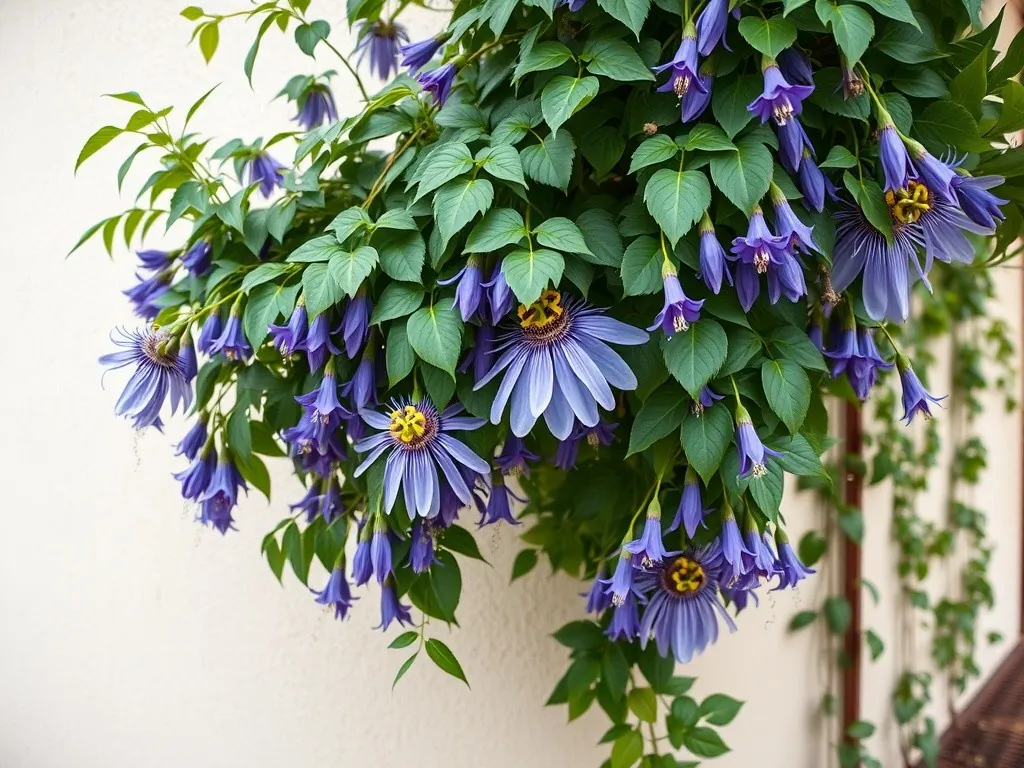
In short
- The flowers of unusual, radial structure bloom from June to September.
- In Poland, outside the warmest spots, it requires cultivation in a pot overwintered indoors or solid protective covering in the ground.
- It climbs by means of clinging tendrils — it needs netting, trellises or cords.
- The orange-yellow fruits ripen in autumn, edible when ripe but less tasty than shop-bought passion fruit.
- It grows very fast during the season — up to several metres in a single summer.
Botanical data
- Family
- Passifloraceae (Passifloraceae)
- Height
- 3–9 m
- Width
- 1–2 m
- Habit
- Cascading
- Growth rate
- Fast
- Position
- Full sun, Partial shade
- Soil
- Humus-rich, Loamy
- pH reaction
- pH 6–7.5
- Moisture
- Moderate
- Bloom
- June–September
- Hardiness
- USDA 8a–10b
- Propagation
- From cuttings, From seed, By layering
Characteristics
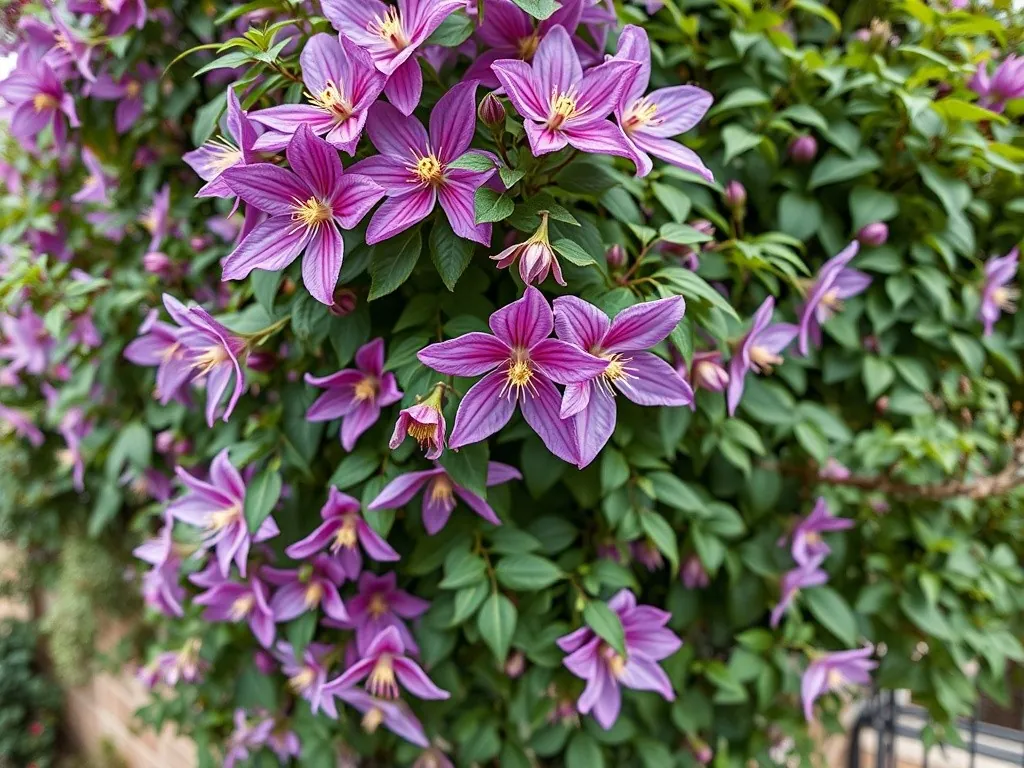
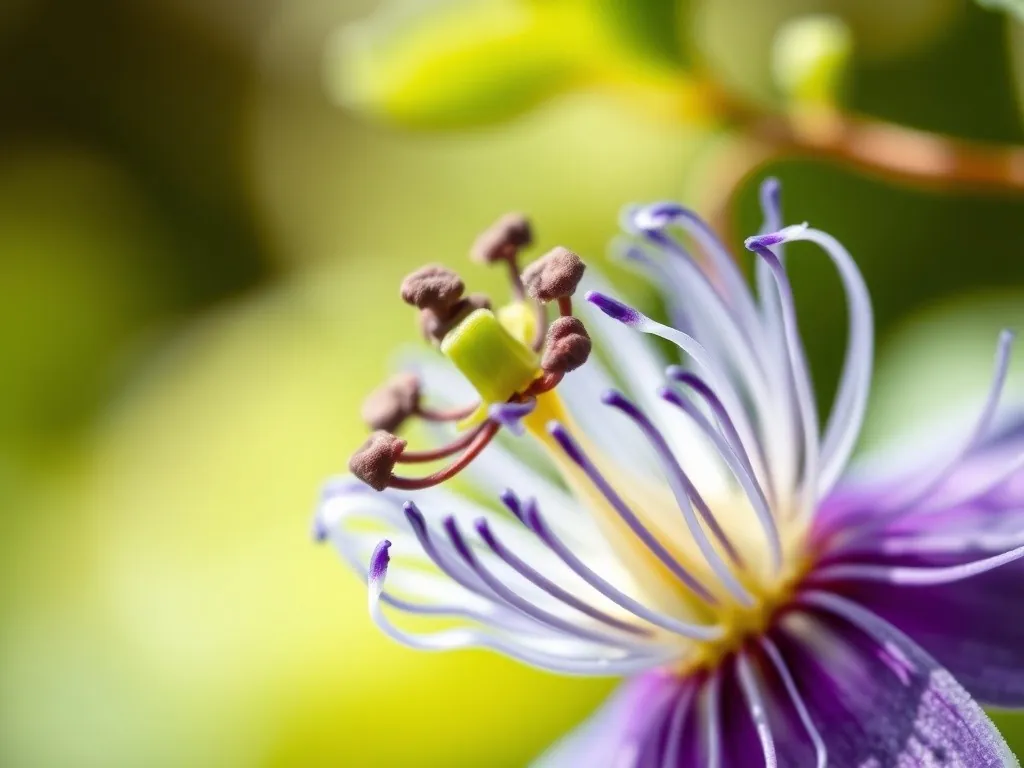
A vine that is herbaceous at the base and becomes woody, climbing by means of spiral tendrils. The characteristic flowers have a flat, radial arrangement of petals around a striking corona of thread-like appendages in white, blue and purple, surrounding the centrally placed pistils and stamens. The fruit is an orange-yellow, egg-shaped berry.
Growing and care
Watering
In Poland, outside the warmest areas, it requires cultivation in a pot moved for winter into a bright, cool room (5–10 °C) or solid covering in the ground in a sheltered spot — it is not fully frost-hardy.
Fertilizing
Stop fertilising in autumn so the plant can prepare for the dormant period.
Planting
In the ground, choose the warmest, wind-sheltered spot, e.g. against a south wall; in cooler regions it is better grown in a large pot.
Pruning
Shorten the shoots by 1/3 to 1/2, removing frost-damaged and weakened parts.
Companion plants
Good companions
Similar warmth and light requirements allow them to be combined at the same sunny and sheltered site, e.g. against a south wall.
A Mediterranean companion that tolerates drier, well-drained soil at the base of the vine well.
Bad companions
The passionflower tolerates waterlogging at the roots poorly, which promotes rot — the proximity of plants requiring constant moisture makes a shared watering regime difficult.
The evidence level indicates whether the relationship is backed by research, observation, or gardening tradition.
Toxicity
| For whom | Level | Notes |
|---|---|---|
| Humans | Mild | Unripe fruits and leaves contain small amounts of cyanogenic compounds — ripe fruits are edible, but less tasty than those of the true passion fruit (Passiflora edulis). |
| Dogs | Mild | — |
| Cats | Mild | — |
History and origin
The genus and species name refers to 16th-century Christian symbolism — Spanish missionaries in South America saw in the structure of the flower symbols of the Passion of Christ (crown of thorns, nails, apostles), hence 'passiflora' and the Polish name 'męczennica'. It was brought to Europe in the 16th–17th century as an ornamental orangery plant.
Uses
For planting up pergolas, trellises and posts in warm, sheltered corners of the garden or on the terrace in a large pot moved indoors for winter. A striking plant for a seasonal exotic accent.
Trivia
- The structure of the passionflower bloom inspired rich religious symbolism as early as colonial times — the corona of thread-like appendages was sometimes read as a crown of thorns.
- The genus Passiflora comprises over 500 species, of which the economically best known is the purple passion fruit (Passiflora edulis), grown for its fruit.
Frequently asked questions
Will the blue passionflower survive the Polish winter in the ground?
Only in the warmest regions of the country and with solid protection (e.g. a thick layer of bark mulch, fleece, straw). In most of Poland it is safer to grow it in a pot and move it for winter into a bright, cool room at 5–10 °C.
Can the fruits of the blue passionflower be eaten?
Yes, the ripe, orange-yellow fruits are edible, though their flavour is much milder and less aromatic than that of the popular shop-bought passion fruit (Passiflora edulis). Unripe fruits and leaves are better avoided — they contain trace amounts of cyanogenic compounds.
What does the passionflower climb by?
It produces spiral clinging tendrils with which it wraps around thin support elements — it needs netting, trellises, cords or a fine lattice, unlike self-clinging climbers such as ivy.
Sources
- Plants of the World Online (POWO)Database (GBIF, POWO…)
- RHS — Passiflora caeruleaInstitution / botanical garden
My note
A private note for this plant — saved in your browser.