In short
- BANNED IN THE EU — it is on the Union list of invasive alien species (Regulation 1143/2014); it may not be bought, kept, transported or released into the environment.
- Considered one of the most invasive plant species in the world: under favourable conditions it doubles its biomass in about two weeks.
- In Poland it does not overwinter — it dies at the first frosts — but the ban applies regardless of climate.
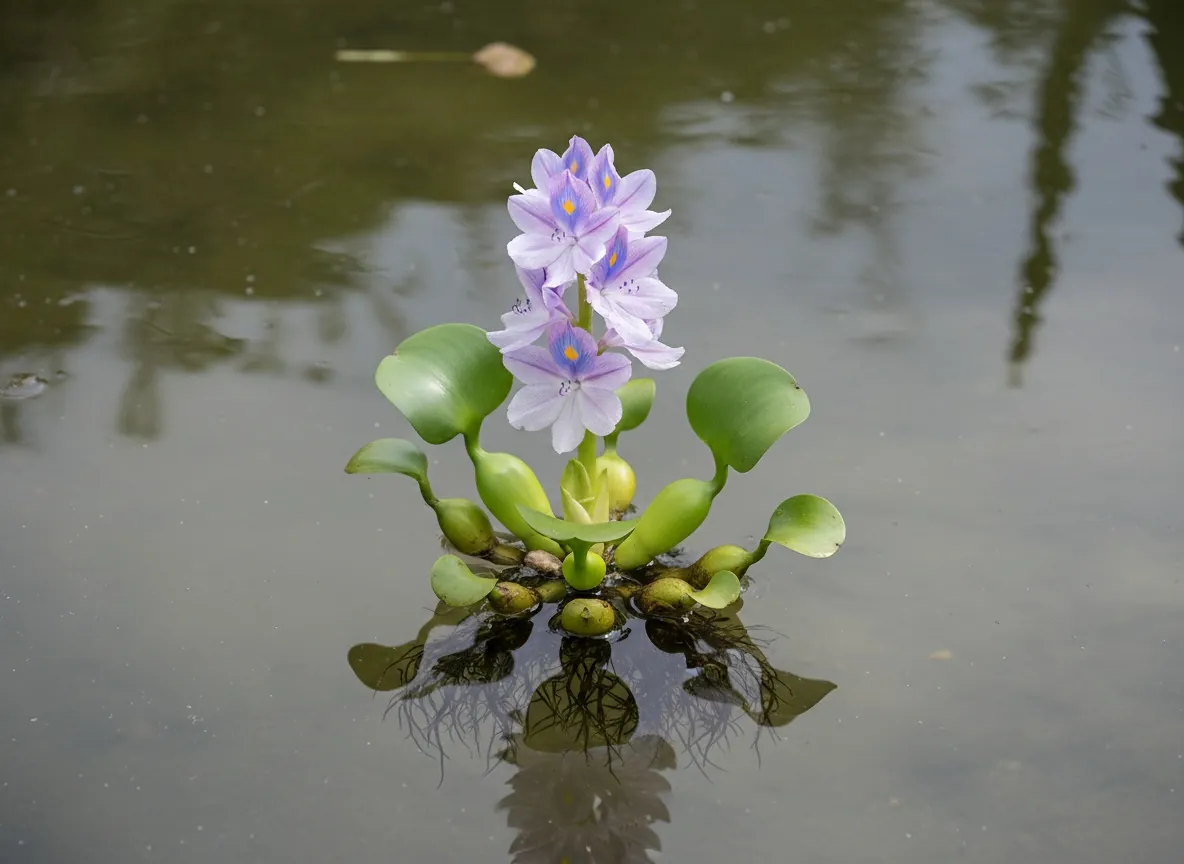
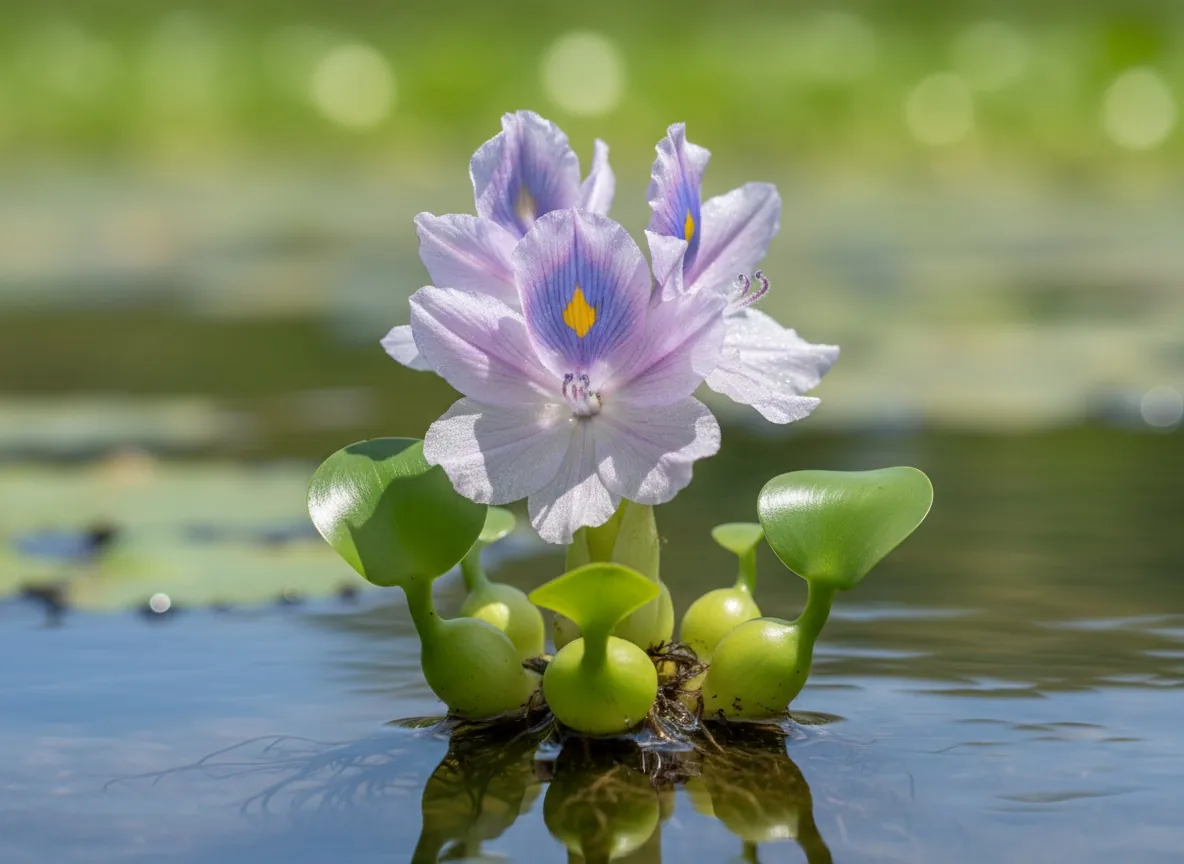
- Recognisable by its swollen, spongy leaf stalks that act as floats.
- Flowers in summer with striking violet-blue spikes bearing a yellow blotch on the upper petal — a single flower lasts only 1–2 days.
- This profile is informative and cautionary in character: we describe a species that must NOT be acquired or planted.
Botanical data
- Family
- Pontederiaceae (Pontederiaceae)
- Height
- 0.15–0.5 m
- Width
- 0.2–0.6 m
- Habit
- Clump-forming
- Growth rate
- Fast
- Position
- Full sun
- Soil
- Humus-rich
- pH reaction
- pH 6–8
- Moisture
- Wet
- Bloom
- July–September
- Hardiness
- —
- Propagation
- By runners, By division, From seed
Characteristics
The plant forms a floating rosette of glossy, rounded to kidney-shaped leaves 5–15 cm across, held above the water on short stalks. The diagnostic feature is the swelling of these stalks into spongy, air-filled bladders that keep the plant at the surface — in young, loosely growing specimens they are globular and clearly marked, while in crowded colonies they elongate and the plant shoots upwards to as much as half a metre. Below the water hangs a dense, feathery tuft of dark roots, several tens of centimetres long, with which the plant captures nutrients directly from the open water. The inflorescence is an erect spike of 8–15 flowers, ranging in colour from pale violet to bluish; the upper petal bears a yellow blotch outlined with a darker pattern that guides insects to the nectar. A single flower lives one, at most two days, after which the stalk bends over and hides the developing fruit beneath the water. Reproduction proceeds chiefly by vegetative means: horizontal stolons grow from the rosette, each ending in a new rosette that quickly becomes independent.
Growing and care
Watering
The plant floats freely and is not watered at all — it takes water and nutrients straight from the open water through its hanging, densely hairy roots. Taken out of the water it withers within a few hours. It is precisely this complete dependence on warm water that causes the species to die at the first frosts in the Polish climate.
Companion plants
Bad companions
Water hyacinth forms a dense, impenetrable mat on the water surface — beneath it, water lilies lose the light their floating leaves need and stop flowering. In practice no aquatic plant will last long in the neighbourhood of a healthy water hyacinth colony.
Submerged plants are the first to die: the water hyacinth mat cuts off almost all light from them, and when its biomass begins to rot it consumes the oxygen dissolved in the water and suffocates everything living in the open water.
The dense mat cuts off gas exchange between water and air, and the decomposition of the dead biomass depletes the oxygen still further — in colonised water bodies this leads to oxygen depletion and mass fish kills.
The evidence level indicates whether the relationship is backed by research, observation, or gardening tradition.
Toxicity
| For whom | Level | Notes |
|---|---|---|
| Humans | None | The plant is not toxic — in Asia it is even sometimes fed to farm animals. Its real danger is ecological and legal, not toxicological: this is a species subject in the European Union to a ban on possession and cultivation. Note, however, that plants from polluted waters accumulate heavy metals strongly. |
| Dogs | None | — |
| Cats | None | — |
History and origin
The world met water hyacinth at an exhibition in New Orleans in 1884, where it was handed out to visitors as an exotic curiosity for garden ponds. The beauty of the flower proved a costly trap: within a few decades the plant had taken over the waters of the southern United States and — carried about by gardeners and collectors — also Africa, Asia and Australia. Its career is a textbook example of a biological invasion. On Lake Victoria in the 1990s the water hyacinth mat cut the ports off from open water, paralysed fishing and transport, and in West Africa it blocked waterways that were the only connection for entire villages. It was called “the blue plague”. The control methods — mechanical removal, herbicides, and finally the introduction of South American weevils that feed exclusively on this plant — consumed enormous resources and brought only partial success. That experience underlies European law: since 2016 the species has been on the list of invasive alien species of Union concern, which means a ban on its sale, cultivation, propagation and release into the environment in all member states, including Poland.
Uses
In Poland and across the entire European Union the plant has NO legal horticultural use — a ban on its sale, cultivation and keeping is in force. We include this profile purely for information, to make the species easier to recognise and to warn against offers that still appear on the internet and at plant fairs, often under the old name Eichhornia crassipes or as “water hyacinth for the pond”. If you are looking for a floating plant to shade the surface of a small water body, reach for the native frogbit — it gives a similar effect, is legal, overwinters in our climate and has real value for nature. A plant acquired by accident must never be thrown into water or a ditch: it should be dried and composted, or disposed of with green waste.
Trivia
- Under optimal conditions a colony of water hyacinth doubles its biomass in about two weeks — ten plants become several dozen after a month, and one hectare can produce several hundred tonnes of fresh matter a year. It was this rate, not the beauty of the flower, that determined its worldwide career.
- The very trait that makes it a plague — the lightning-fast uptake of nitrogen and phosphorus from the water — is sometimes put to use in controlled sewage treatment plants in tropical countries. In Asia, furniture and handbags are also woven from the dried stems. These are, however, industrial applications under strict control, and not an argument for keeping the plant in the garden.
- Until recently the plant was classified in the genus Eichhornia, and under the name Eichhornia crassipes it still appears in most of the older literature and in legal texts. Molecular research has placed it in the genus Pontederia, and that is the name in force today.
Frequently asked questions
Can water hyacinth be legally bought and planted in a garden pond in Poland?
No. The species is on the Union list of invasive alien species of Union concern (Regulation 1143/2014), which means a ban on its import, sale, cultivation, propagation, transport and release into the environment — in Poland as well. Offers that still appear on the internet, at plant fairs or under the old name Eichhornia crassipes are unlawful. The fact that the plant will not survive our winter in the ground does not change the legal position.
If water hyacinth will freeze out in Poland anyway, why is it banned?
The ban does not rest solely on the ability to overwinter. The plant will easily survive a season in heated waters — where warm water is discharged from power stations or industrial plants — and in a single season it can build a mat that chokes an entire water body. Added to this are the warming winters, the cost of any control effort, and the very fact that every traded specimen increases the risk of the species being carried further into southern Europe, where it overwinters without difficulty. EU law covers the whole Union equally, regardless of the local climate.
What plant will replace water hyacinth in a small pond?
The closest legal counterpart is frogbit — a native, free-floating plant that forms rosettes of round leaves, shades the surface and limits algae, and overwinters here as buds that sink to the bottom. If you care about a large, showy flower, consider white water lily or fringed water lily in the deep zone. All three are native, safe for the environment, and do not require buying new plants every year.
Sources
- Plants of the World Online (POWO) — Pontederia crassipesDatabase (GBIF, POWO…)
- Rozporządzenie wykonawcze Komisji (UE) — lista inwazyjnych gatunków obcych stwarzających zagrożenie dla Unii (rozporządzenie 1143/2014)Institution / botanical garden
My note
A private note for this plant — saved in your browser.