In short
- It does not root in the bottom — it floats freely, with its roots hanging loosely in the water column.
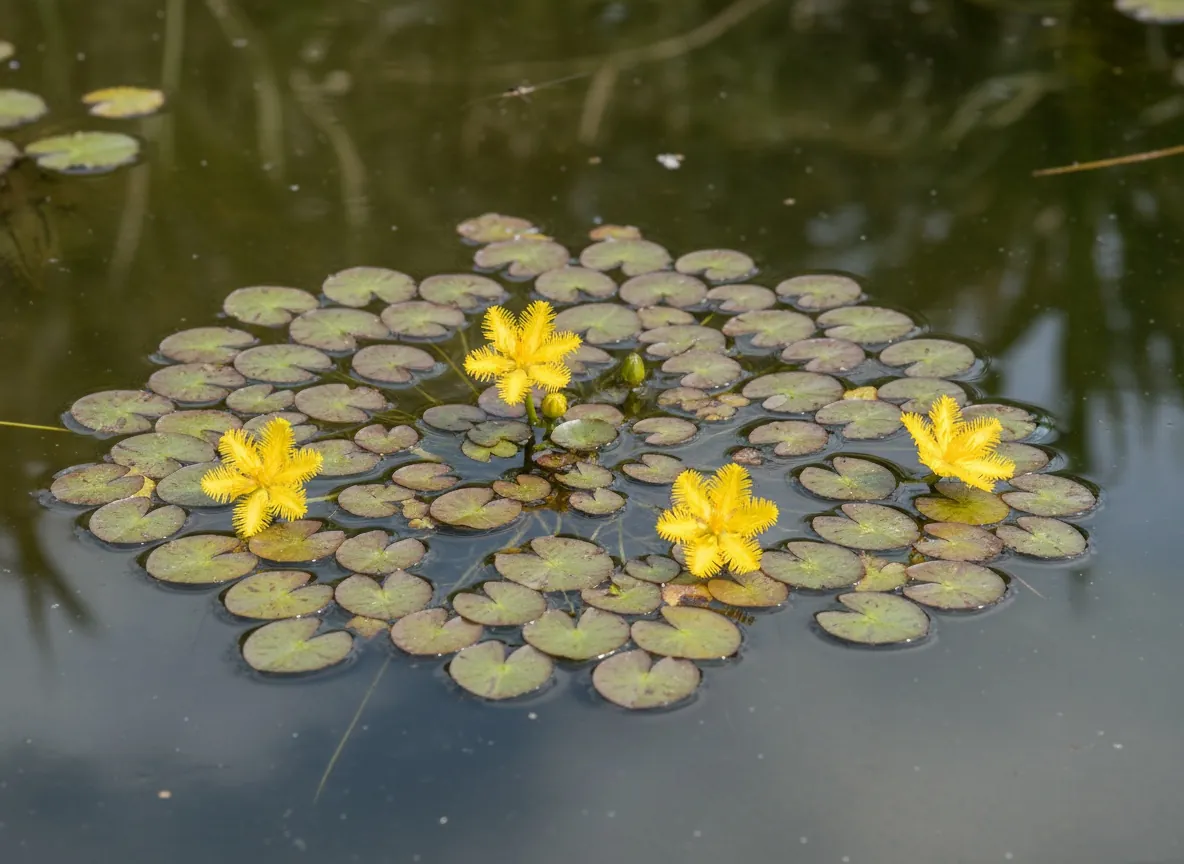
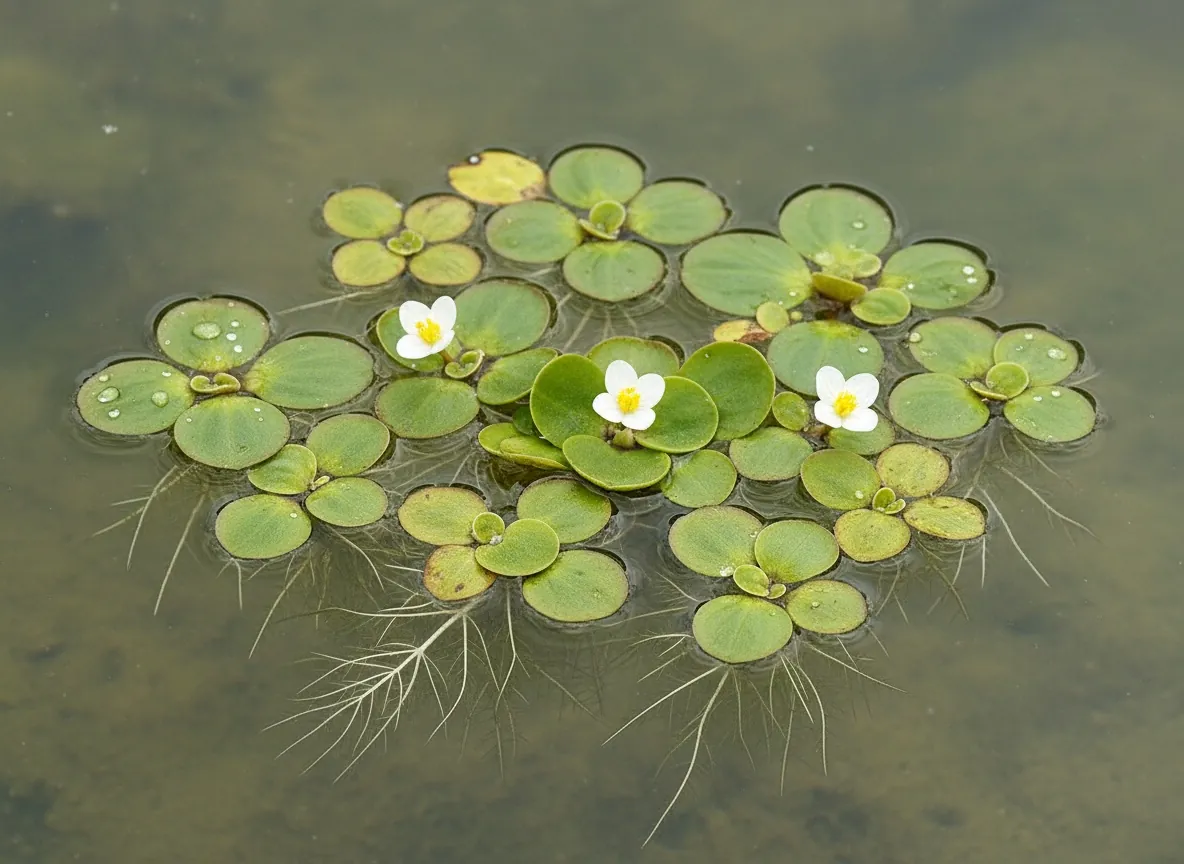
- The rosettes of round leaves, heart-shaped at the base, look like water lilies in miniature (the leaf is 2–5 cm).
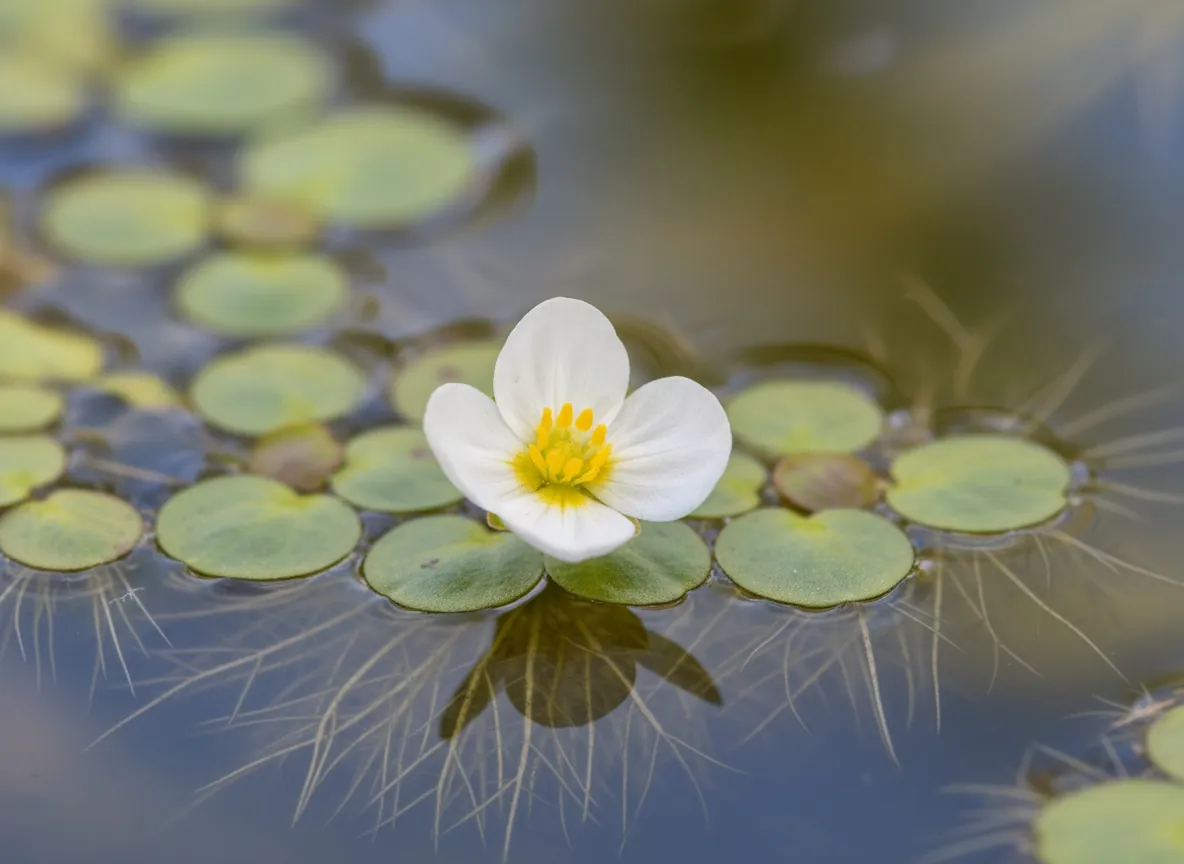
- It flowers from June to August with small, white, three-petalled flowers with a yellow centre.
- It overwinters as turions — winter buds that sink to the bottom in autumn and float up in spring.
- It requires calm water sheltered from wind; it does not tolerate a fountain or a current.
- It spreads across the surface by stolons — surplus rosettes are simply lifted out with a net.
Botanical data
- Family
- Hydrocharitaceae (Hydrocharitaceae)
- Height
- 0.02–0.05 m
- Width
- 0.2–0.5 m
- Habit
- Creeping
- Growth rate
- Fast
- Position
- Full sun, Partial shade
- Soil
- Humus-rich, Peaty
- pH reaction
- pH 6.5–8
- Moisture
- Wet
- Bloom
- June–August
- Hardiness
- USDA 4a–9b
- Propagation
- By runners, By division, From seed
Characteristics
A plant with a shortened stem forming a rosette of 3–8 leaves floating on the water surface. The leaves are round to kidney-shaped, heart-shaped at the base, 2–5 cm across, leathery and glossy, with a spongy air tissue beneath providing buoyancy — the whole resembles a water lily in miniature, though it is not related to one. The roots, over a dozen centimetres long, hang freely in the water and do not reach the bottom. The flowers are small (2–3 cm), white, with three delicate petals bearing a yellow blotch at the base, held just above the surface; the plant is dioecious, so in a single colony one usually encounters flowers of only one sex, and seed is set rarely. The main means of reproduction is by stolons: horizontal shoots grow from the rosette and end in a new rosette, so that the colony spreads across the surface, flat over the water.
Growing and care
Watering
The plant floats freely on the surface and is not watered at all — all that matters is a steady water level in the pond. A rosette lifted out of the water withers within a few hours, which is why in shallow containers the water that evaporates in summer must be topped up.
Planting
It requires no substrate or basket — the rosettes are simply laid on the surface of calm water, and their roots hang freely in the water column and do not reach the bottom. The condition for success is a sheltered, quiet spot: wind and the jet from a fountain push the rosettes to one bank and break up the colony.
Pruning
Simply lift out the surplus rosettes with a net when the colony begins to cover more than half of the water surface. Leave the harvested biomass on the bank for a few hours, so that small aquatic animals can return to the pond, and then put it on the compost.
Companion plants
Good companions
The tall clump of iris in the marginal zone shelters the water surface from wind, and frogbit needs precisely calm water — without shelter the rosettes are pushed to one bank and the colony breaks up.
Submerged oxygenating plants compete with algae for nutrients and keep the water clear, which benefits frogbit — and it in return shades the surface and further limits algal blooms.
Bad companions
It occupies exactly the same niche — the water surface — but multiplies faster and forms a dense mat, beneath which the rosettes of frogbit are smothered and stop flowering.
The huge leaves of the lotus rise high above the water and completely shade its surface — the small, light-loving frogbit languishes beneath them and disappears.
The evidence level indicates whether the relationship is backed by research, observation, or gardening tradition.
Toxicity
| For whom | Level | Notes |
|---|---|---|
| Humans | None | — |
| Dogs | None | — |
| Cats | None | — |
History and origin
Frogbit has always been a component of European oxbow lakes, floodplains and peat-cutting ditches — it has no history of cultivation or economic use behind it, but it is a good witness to changes in the aquatic landscape. River regulation, the draining of oxbow lakes and the eutrophication of waters have caused it to thin out markedly in many regions of Poland and Western Europe, though nationally it is still a fairly frequent species and not legally protected. The opposite fate met it in North America, where it arrived in the 20th century by way of botanical gardens — there, without natural checks, it has taken over the canals and floodplains of the Great Lakes basin and is fought as an invasive species.
Uses
A plant for small garden ponds, tubs and container mini-ponds on a terrace, where water lilies would be far too large. It shades the water surface, limiting the development of algae, and its trailing roots provide shelter for fry and small aquatic invertebrates — hence its high natural value despite its modest appearance. It works well in naturalistic plantings and wherever a native species matters more than exotic floating plants. On one condition: the water must be calm and sheltered.
Trivia
- The specific name morsus-ranae means literally “frog's bite” — it alludes to the notch at the base of the leaf, which looks like the mark of a bite.
- In autumn the plant produces turions — compact, starch-rich winter buds that detach and sink to the bottom, where they wait out the freezing of the surface. In spring they accumulate gas, float to the surface and develop into new rosettes; this is why a pond that looks quite empty in autumn is covered with frogbit again in May.
- Although it looks like a miniature water lily, it belongs to an entirely different family — the frogbit family (Hydrocharitaceae), the same as Canadian waterweed.
Frequently asked questions
Does frogbit have to be planted in a basket on the bottom?
No. It is a freely floating plant — it does not root in the bottom, and its roots hang loosely in the water column and take nutrients straight from it. The rosettes are simply laid on the water surface and nothing more needs doing. The only important thing is that the spot be sheltered from wind and free of a fountain, because the current pushes the rosettes to one bank.
My frogbit disappeared in autumn — has the plant died?
Most probably not. Frogbit overwinters in the form of turions, that is, winter buds, which in autumn detach from the rosettes and sink to the bottom of the pond. In spring, when the water warms up, they float to the surface and develop into new rosettes. This is why the bottom of a pond should not be cleaned down to the bare liner in autumn — removing the sediment together with the turions means that the plant will not return.
Does frogbit overgrow a garden pond?
In fertile water it can spread quickly and cover a considerable part of the surface, but unlike plants that spread by rhizome it is very easy to control — it is enough to lift out the surplus rosettes with a net and throw them on the compost. A good threshold is to leave roughly half of the water surface exposed, so that submerged plants have enough light.
Sources
- Plants of the World Online (POWO)Database (GBIF, POWO…)
- GBIF — Hydrocharis morsus-ranaeDatabase (GBIF, POWO…)
My note
A private note for this plant — saved in your browser.